How to Score Sourdough (Angle, Depth & Timing)
Score sourdough with the right lame or knife, angle and depth, and cut cleanly through heavy or inclusion dough for a tall ear.
By Maya Ellison · Reviewed by Maya Ellison · Updated August 30, 2026 · 6 min read
Quick answer
The moment before the loaf goes in is the most decisive one in the whole bake. The score tells the dough exactly where it may open, and everything after it — the ear, the silhouette, the spring — follows from that single stroke. This guide is about the mechanics of the cut itself: the tool in your hand, the angle, the depth and the timing, plus how to keep the score clean when the dough is heavy with chocolate, nuts, cheese or berries.
Why scoring decides the loaf
As a cold, proofed loaf hits the oven, the gas trapped inside expands hard and fast — that burst is oven spring. A scored loaf has a planned weak point, so it opens along your cut and blooms upward. An unscored or badly scored loaf opens wherever the skin is thinnest, usually a side seam or the bottom, which is how you get bulges and blowouts instead of a clean ear.
The ear itself is a side effect of good mechanics: the shallow angle lifts a flap of crust, and as the loaf springs, that flap dries and curls into the classic lip. Get the angle and depth right and the ear is earned, not chased. The patterns you draw on top are a separate question — that's covered in the scoring designs guide.
The tools: lame, razor or knife
Any blade will cut dough; the question is whether it cuts the dough or tears it.
- A lame (curved or straight) is the standard: a razor-sharp blade on a short handle, thin and flexible enough to travel along the 30–45° path without levering the crust up.
- A single-edge razor blade held between finger and thumb works identically and costs almost nothing. Many professional bakers prefer the feel.
- A thin, very sharp knife is fine for a firm, chilled loaf. Use one long glide at a low angle; if the blade is thick or dull it compresses the dough and drags.
Whatever you use, sharpen or replace it often. A dull edge does not slice — it presses, then tears, and the skin never re-seals cleanly.
Angle and depth: the two dials
Every scoring system reduces to two decisions on the blade.
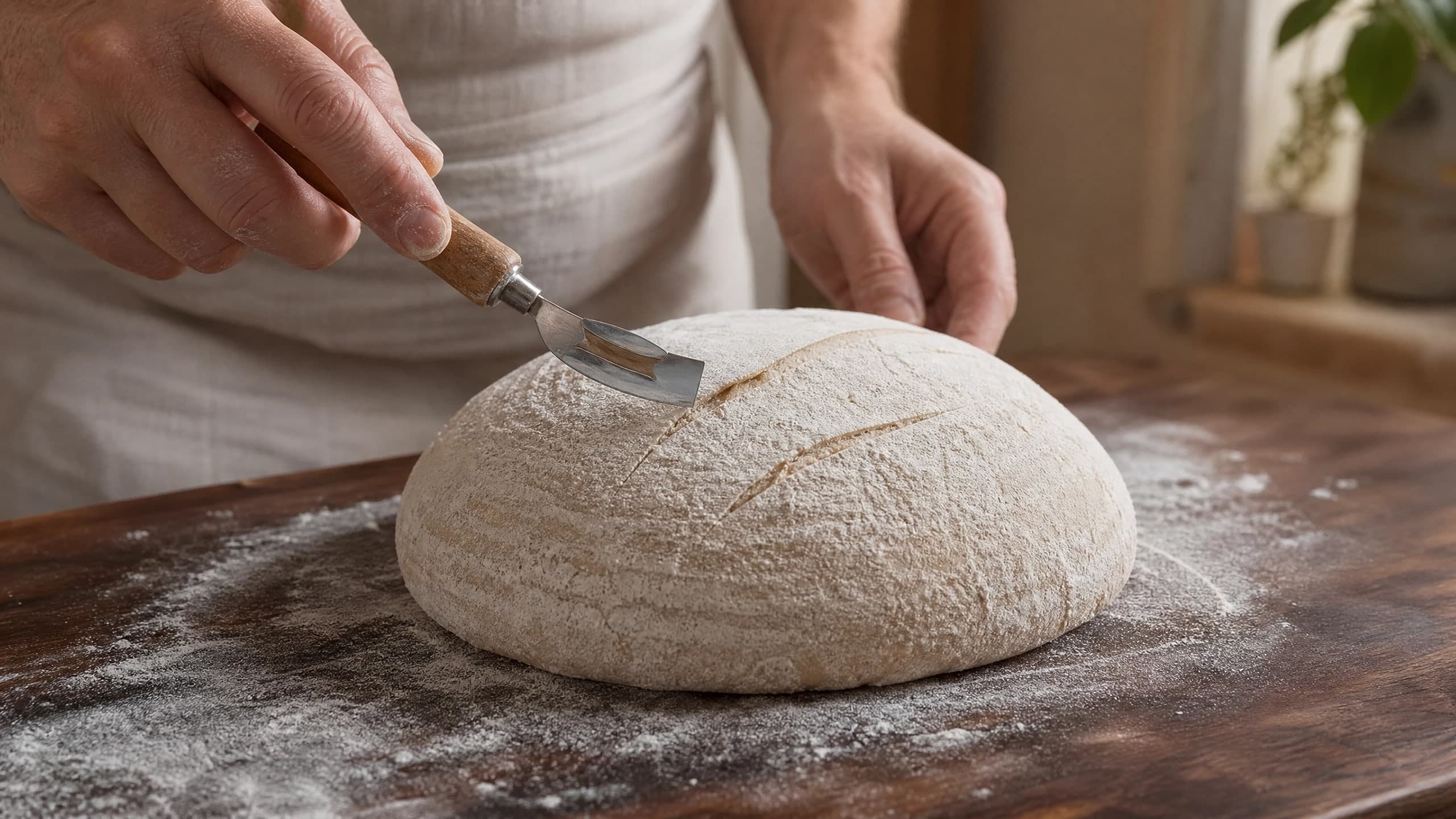
Angle. Hold the blade nearly parallel to the dough surface, tilting down at roughly 30–45°. Steeper than that and you dig a trench that collapses closed; flatter and you only graze the flour dust without opening the structure. The shallow angle is what produces the ear: the blade slides just under the surface and lifts a flap as it slides through.
Depth. About 1 cm (½ in) into an average boule or batard. Shallow cuts re-seal in the first minutes of baking — the skin knits back together and the gas moves on to burst somewhere worse. Deep cuts do the opposite: they slice through the structure that would have given you height, so the cut gapes and the loaf settles.
One stroke, full length. Competent scorers move the blade from one edge almost to the other in a single continuous motion. Sawing, hesitating or going back over the same line tears the skin and produces a ragged, gummy opening.
When to score and bake from cold
Score immediately before baking, and if you can, score a cold loaf.
- Cold skin cuts cleaner. A loaf chilled 20–30 minutes (or cold after an overnight proof) has a firm, slightly dry surface that the blade glides through. Warm, tacky skin sticks to the blade and drags.
- Cold dough holds its shape. Once cut, a cold loaf sits still long enough for the oven to set the rim. A warm loaf settles and the cut softens before it springs.
- The cut needs the oven's heat. Score, then get the loaf into the pot without delay so the skin doesn't re-seal while it sits on the bench.
This is why the classic flow is shape → proof → fridge → oven: the overnight chill firms the skin, deepens flavor and hands you a loaf that scores cleanly at whatever hour you bake. To keep the final proof independent of the fridge, see the proofing guide.
Scoring heavy and inclusion-loaded doughs
The recipes that link here are the ones where scoring gets real: a baguette that needs a clean release, a chocolate loaf, a jalapeño-cheddar boule, blueberry-lemon, and any dough loaded with nuts or dried fruit. The same mechanics apply with one important addition — the blade has to travel past interrupters.
- Chill longer. Give a loaded loaf 20–30 minutes in the fridge so the skin firms around the inclusions. A warm dough lets the chunks shift under the blade.
- Cut deeper, by a hair. Around 1.25 cm for a dough with large inclusions. The soften-the-structure balance still holds, but a shallow cut catches the first chunk and stops, which is exactly when the loaf blows out next to the score.
- One clean diagonal across the strongest point. Ingredients crowd the middle, so cut the main score across the loaf's highest point where the dough will rise, not over a visible pocket of chocolate.
- Expect dry inclusions to cut, wet ones to resist. Nuts, seeds and chocolate score almost like a plain crust once the blade is sharp. Fresh berries, cheese or olives are softer and wetter — they pull and smear, so give them a shallower stroke and let side cuts carry the design.
The sourdough inclusions guide explains how add-ins change the dough itself; the sourdough baking guide covers what happens after the score hits the heat.
Common scoring mistakes
- A dull blade. It presses instead of slicing and the skin tears instead of opening. Replace blade or sharpen before every bake.
- Scoring too early. The cut re-seals while the loaf waits; you lose the release and the ear. Score at the oven.
- Too shallow or too short. The skin knits shut and the loaf erupts at a seam. Full depth, nearly edge to edge.
- Sawing strokes. Each pass tears fresh skin. One continuous cutting line beats five tentative ones.
- Warm, tacky dough. The blade drags and the cut closes. Firm the skin in the fridge first.
- Over-proofed dough. No score can rescue a loaf that is past its peak — it erupts regardless. Pull the bake earlier (the poke test tells you when it's ready).
References
- King Arthur Baking — bread scoring technique resources: kingarthurbaking.com — test kitchens documenting lame angle, depth and cold-scoring practice.
- Reinhart, P. (2001). The Bread Baker's Apprentice. Ten Speed Press — the framework for oven spring, blisters and the baker's approach to cutting dough.
- Robertson, C. (2010). Tartine Bread. Chronicle Books — standard cold-proof-then-score method used across artisan sourdough baking.
Frequently asked questions
When should I score sourdough bread?
Immediately before baking, ideally while the loaf is cold from the fridge. A cold, firm-skinned dough cuts cleanly and keeps its shape, which is why most bakers shape, proof in the fridge overnight and score straight into the hot oven. Scoring earlier lets the cut re-seal as the skin dries.
What angle should a lame be when scoring sourdough?
A shallow angle of about 30–45° to the dough surface. That tilt is what lifts a flap of crust into an ear; a steep blade cuts a vertical trench that collapses and a flat one just grazes the surface. The shallow angle peels dough sideways instead of cutting straight down.
How deep should I score sourdough?
About 1 cm (½ in) for a standard boule or batard. Too shallow and the cut re-seals and the loaf blows out at the side or bottom; too deep and the structure under the cut slumps and the loaf loses height. A chilled loaf makes a decisive 1 cm cut easy.
Do I need a lame to score sourdough, or can I use a knife?
A lame or a single-edge razor gives the cleanest cut because the blade is razor sharp and flexible enough to follow the angle. A sharp thin knife works well on firm, chilled dough — just use one long glide rather than a sawing motion. A dull blade pulls and tears the skin, leaving a ragged opening.
How do I score a loaf with chocolate, nuts or cheese in it?
Chill it for 20–30 minutes so the skin tightens, then cut a touch deeper — about 1.25 cm — and longer than you would on a plain loaf. Inclusions interrupt the blade, so a sharp edge and a decisive stroke matter more than ever. Dry ingredients like nuts and chocolate cut cleanly; very wet ones like berries or cheese may just need shallower decorative cuts in addition to the main score.
Why does my sourdough blow out next to the score?
The score was too shallow, too short, or made too late. When the skin re-seals, the expanding gas finds its own exit. Fix it by chilling the loaf, cutting a full 1 cm, reaching almost from edge to edge, and baking from cold. An over-proofed loaf erupts no matter how you cut, so also check the final proof.