Baking Bread Proofing: Times, Signs and Temperature
Baking bread proofing explained: what proofing is, a bread proofing chart for sourdough at every dough temperature and the signs your dough is ready.
By Maya Ellison · Reviewed by Maya Ellison · Updated August 18, 2026 · 5 min read
Quick answer
Proofing is the stage that decides whether your loaf rises tall in the oven or flattens on the counter — and it is the stage home bakers most often get wrong. This guide explains what proofing actually means, hands you a bread proofing chart you can stick on the fridge and shows you the four signs that a dough is truly ready for the oven.
What is proofing?
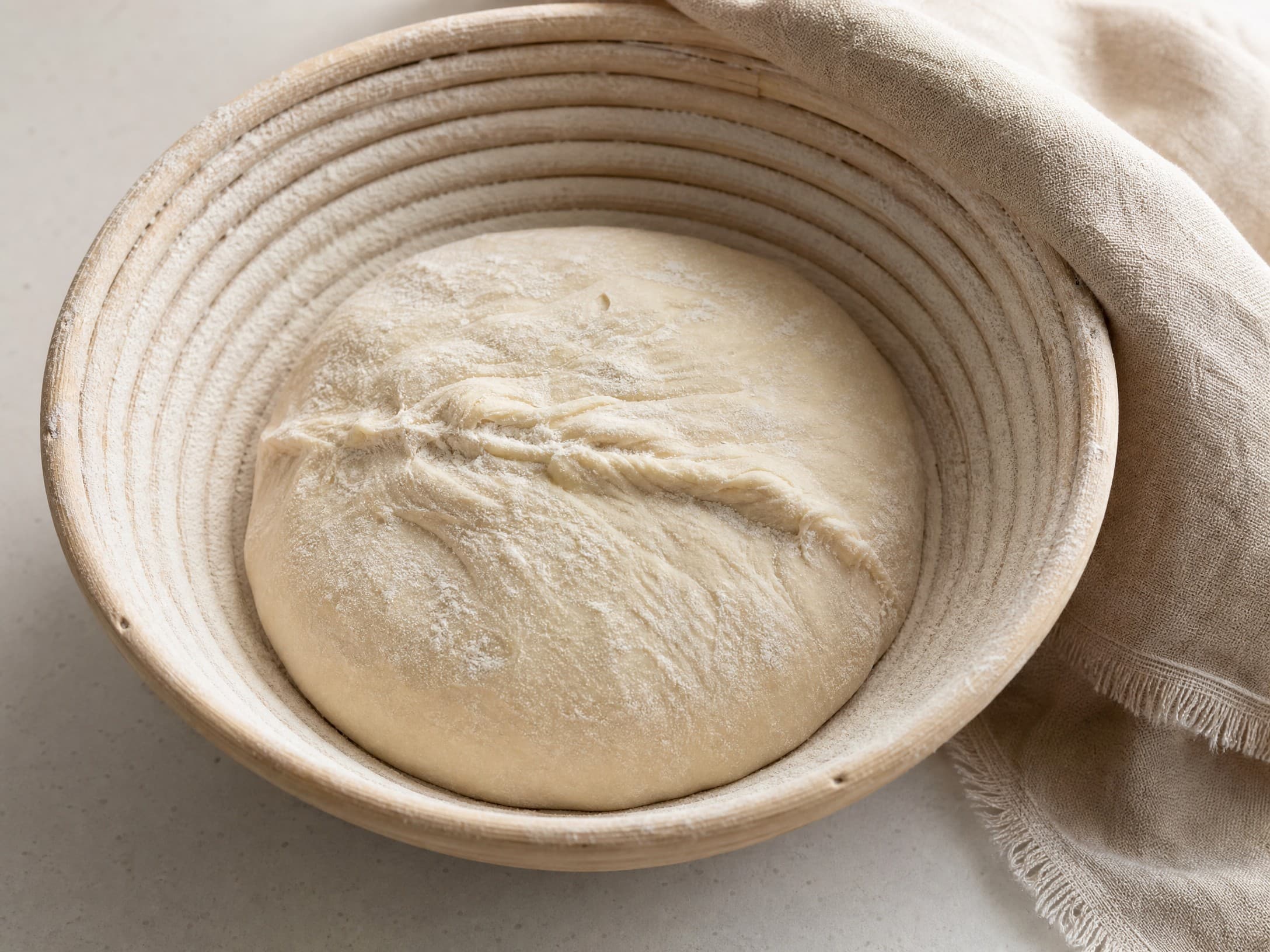
In the strict sense, proofing is the final rise: the dough has been divided, pre-shaped, given its final shape and now sits in its banneton or bowl until it is ready to bake. This is the final proof and it has one job — to fill the shaped loaf with enough gas to spring in the oven while the gluten relaxes enough to stretch instead of tear.
Home bakers also use the word for the first rise, the bulk fermentation, when the whole mixed dough rests in one piece. You will see both uses constantly. "Proof for 4–5 hours" usually means bulk; "proof the shaped loaves" means final. The two stages do different work: bulk fermentation builds flavor and gas and the final proof concentrates that gas into the structure of one loaf. If a recipe does not specify, assume bulk when the dough is one mass in a bowl and final proof when it is shaped.
The bread proofing chart
The chart assumes a typical, well-fed sourdough at 100% hydration resting at the listed dough temperature — in yeast terms, roughly the rate of a dough made with about 1.8% commercial yeast. These are approximates for the full proofing window (bulk plus final proof) of a standard sourdough schedule:
| Dough temperature | Approximate proof time | Typical range |
|---|---|---|
| 60°F / 15°C | about 12 hours | 10–14 hours |
| 65°F / 18°C | about 8 hours | 7–9 hours |
| 70°F / 21°C | about 5 hours | 4–6 hours |
| 75°F / 24°C | about 3 hours | 2.5–3.5 hours |
| 80°F / 27°C | about 2 hours | 1.5–2.5 hours |
Read the table as ranges, not deadlines. Your starter's strength, the hydration of the dough and the recipe all shift the whole curve up or down by an hour or two. The pattern underneath is the one that matters: every 5°F (3°C) of dough temperature moves the timeline by roughly a third, which is why the same recipe can take 5 hours in June and 9 hours in January without anything changing but the kitchen.
Signs your dough is done proofing
The clock is a suggestion; the dough is the authority. When three of these four are true, heat the oven:
- 70–80% rise. The shaped dough has grown about three-quarters beyond its shaped size. Less than that and the crumb will be dense; past double and the loaf is flirting with over-proofing.
- The jiggle. Give the banneton a gentle side-to-side shake. A ready dough wobbles like gelatin — the whole mass moves, not just the surface. A stiff, immobile dough still needs time.
- The dome. The surface has domed up near the rim of the basket and the corners have rounded off. A flat, spreading surface says the gluten has gone slack.
- The poke test. Press a floured finger about 1/2 inch (1.25 cm) into the dough for a second. A slow spring that leaves a faint indent means ready. There is a full walkthrough in the dough poke test guide.
Over-proofed vs under-proofed: how to tell
| Under-proofed | Over-proofed | |
|---|---|---|
| Poke test | springs back fast, indent vanishes | indent stays, dough feels lifeless |
| Surface | tight, stiff, slow to rise | domed past the rim or spreading flat |
| Jiggle | barely moves | quivers like a loose pudding |
| In the oven | bursts along the side, big tunnels | little spring, wide flat loaf |
Both are recoverable in their own way. An under-proofed loaf bakes denser but tastes fine — many bakers would rather be here than anywhere else. An over-proofed loaf bakes flat and gummy; bake it anyway, score it shallowly and shorten the proof by a third next time. The fix for both is the same: learn to read the signs and adjust by feel, not by the clock.
Temperature is the whole story
Nothing controls proofing like dough temperature. Roughly, fermentation speed doubles for every 9°F (5°C) the dough warms — the single number behind the whole chart above. A dough at 75°F finishes in hours; the same dough at 66°F needs all night. This is why the dough temperature guide is the most useful page on this site: hit 72°F (22°C) at mix time and the entire proofing schedule falls into place.
The fridge is the other side of the coin. A cold proof at 38–40°F (3–4°C) for 12–24 hours is a deliberate tool, not a compromise: it pauses the dough mid-proof, sharpens the flavor and makes scoring effortless because the crust is firm and cold. If your day collapses, cold-proofing is the pause button every sourdough baker relies on.
The rest is practice. Proof a few loaves while noting the temperature, timing and the rise each time and within a month you will walk into any sourdough bread recipe, on this site or anywhere and know before the timer does whether the dough is ready. If you are starting from zero, the beginner's guide to sourdough lines up every stage of the bake in order.
Frequently asked questions
Is proofing the same as rising?
In everyday baking, yes — proofing is the rise that happens after shaping and many recipes use 'rise' for bulk fermentation and 'proof' for the final rise. Both stages are fermentation; they are just different points on the same schedule.
How long should bread proof at room temperature?
For a typical sourdough, about 5 hours at 70°F (21°C), 3 hours at 75°F (24°C) and 8 hours at 65°F (18°C) — check the chart above. Your starter strength and recipe move the numbers by an hour or two, so treat the chart as a map, not a deadline.
Can I proof bread dough in the fridge?
Yes and it is a great habit. A cold proof at 38–40°F (3–4°C) for 12–24 hours pauses the rise, deepens the flavor and makes the dough easier to score. The dough will still finish rising slowly in the cold — the signs above still apply, just stretched over many hours.
What happens if bread proofs too long?
The dough over-proofs: it spreads flat, loses oven spring and can collapse in the oven, leaving a dense, gummy crumb with a harsh tang. It is not dangerous to eat; if it is already slack, bake it anyway, score it shallowly and expect a wider loaf.
Why do some recipes say 'proof' about the whole dough before shaping?
That is bulk fermentation borrowed into the word proof by shorthand. When the dough is still one mass in a bowl it is in bulk; once it is in its final shape it is in the final proof. The two stages share the same temperature rules, which is why they get lumped together.