Digital Kitchen Scale for Bread Making
How to choose a digital kitchen scale for bread making: precision, capacity, tare and pull-out displays — plus our pick for most sourdough bakers.
By Maya Ellison · Reviewed by Maya Ellison · Updated August 18, 2026 · 4 min read
Quick answer
A digital kitchen scale for bread making is the highest-leverage tool in the sourdough kitchen — ahead of the Dutch oven, the banneton, even the starter itself. Bread is ratios, not recipes: 100 g flour, 70 g water, 20 g starter, 2 g salt. Scoop flour with a cup and you're guessing within ±10 g; bake a recipe in volume and you have no idea what you actually made. A scale turns baking from luck into repeatable process.
Why a scale matters more than the recipe
Sourdough lives on ratios. Hydration — water weight divided by flour weight — drives everything: how the dough feels, how it holds gas, how open the crumb ends up. Drop 5 g of water out of a 70% hydration dough and it's a different dough. Add 5 g more salt and fermentation slows noticeably. A tablespoon of flour weighs anywhere from 5 to 10 g depending on how it was scooped. In cups, every loaf is a surprise; by weight, every loaf is reproducible. Your starter's 1:1:1 feeding only means something when all three parts are weighed.
What to look for in a baker's scale
- Precision of 1 g. 0.1 g is optional; 1 g is the floor for bread.
- Capacity of 2–5 kg. A mixing bowl with 1 kg of dough passes 2 kg quickly. 5 kg covers everything a home baker does.
- Tare function. Zero the bowl, add flour, zero again, add water — no mental arithmetic.
- Auto-off with a real delay. Useful when it waits 60+ seconds; infuriating when it cuts out mid-weigh with dough in the bowl.
- Readable display. Large, backlit digits matter when your hands are covered in flour.
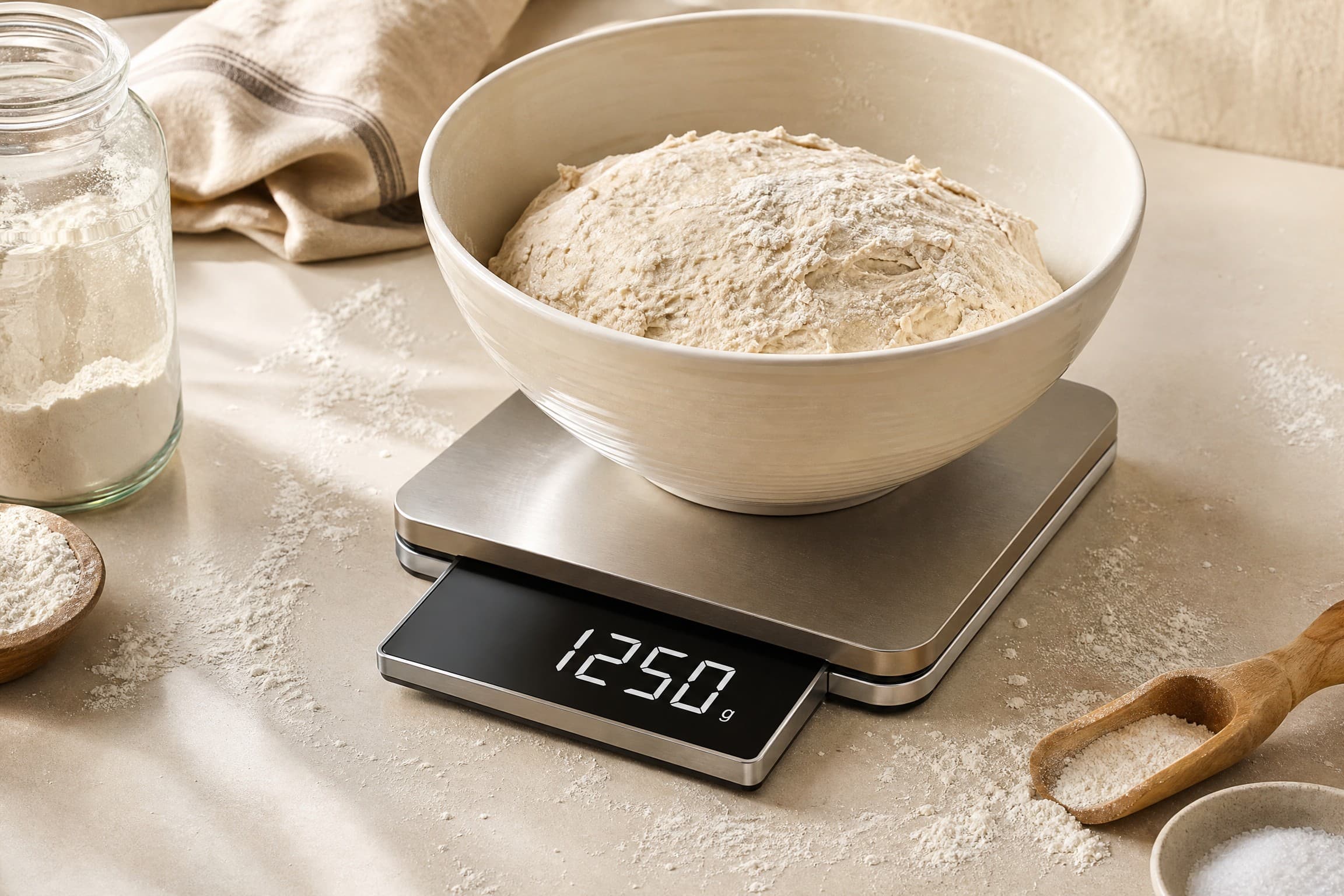
- Pull-out display. The single most useful feature — you can read the number even when a big bowl covers the platform.
- Long battery life. Most run on button cells or AAA; a scale that dies mid-feeding is a scale you stop using.
Weigh in grams, not ounces. Baker's percentages are built around grams; ounces force decimal math at exactly the moment you don't want to do any. Every recipe on this site is in grams for that reason.
Four types of scale compared
| Type | Good for | Weight limit | Precision | Cons |
|---|---|---|---|---|
| Budget kitchen scale | Everyday measuring on a small budget | 5 kg | 1 g | Eager auto-off, slow response, plastic buttons |
| Mid-range with pull-out display | The everyday workhorse for home bakers | 5 kg | 1 g | Costs more than the budget option |
| High-precision jeweler-style (0.1 g) | Starter feedings and tiny salt or yeast additions | 2 kg | 0.1 g | Small platform, low capacity, fiddly buttons |
| Large-capacity commercial | Big batches, heavy bowls, small-batch baking businesses | 10–15 kg | 1 g | Bulky, expensive, overkill for one loaf |
Budget kitchen scale
Pros: cheap enough to buy two; accurate to 1 g out of the box; fits in a drawer. Cons: auto-off cuts in mid-weigh; display hidden by big bowls; plastic buttons degrade.
Mid-range with pull-out display
Pros: readable while weighing any bowl; 1 g precision and 5 kg capacity cover 99% of bakes; fast tare and response. Cons: more expensive than the budget option; the display cable adds a little counter clutter.
High-precision jeweler-style (0.1 g)
Pros: measures starter feedings and a 2 g salt addition with real precision; tiny footprint. Cons: platform too small for a dough bowl; 2 kg capacity arrives fast; you rarely need 0.1 g.
Large-capacity commercial
Pros: weighs the heaviest batches and bulkiest bowls; built like a tank. Cons: expensive and bulky and precision is still 1 g — you're paying for capacity you don't need.
Our recommendation
Two honest caveats. If you keep a tiny starter (under 50 g), a small 0.1 g jeweler scale earns its place for feedings — but keep the pull-out model for dough. And if budget is the real constraint, a cheap 1 g scale genuinely works; just expect the auto-off to test your patience mid-bake.
Check priceNew to weighing? The beginner's guide to sourdough walks through the first bake step by step and our classic sourdough bread recipe is written entirely in grams, so your new scale goes to work on day one.
Frequently asked questions
Do I need 0.1 g precision, or is 1 g enough?
1 g precision is enough for everything a home baker weighs: flour, water, starter and salt. 0.1 g only matters for tiny additions under a few grams — like feeding a 5 g starter or weighing a small amount of yeast. If you bake normal-sized loaves, a 1 g scale is the right tool.
Can I bake with a cheap kitchen scale?
Yes — any scale that reads in 1 g increments and handles 5 kg will work for bread. The cheap ones feel flimsy, respond slowly and sometimes auto-off mid-weigh, but if yours tares and reads grams, you can absolutely bake great sourdough with it.
How do I calibrate a kitchen scale?
Most scales have a CAL button or calibration mode: press and hold it, then place the calibration weight (often 500 g or 1 kg) on the platform when prompted. No calibration weight? A full 500 ml water bottle weighs 500 g and works as a stand-in.
Why does my scale drift during a long bake day?
Weak batteries and temperature changes cause drift. Swap in fresh batteries if readings wobble and always weigh on a flat, level surface — never on a towel or the edge of the counter.