Sourdough Scoring Designs: A Beginner's Guide
Sourdough scoring designs for beginners: why we score, how to hold a lame, simple cuts like the single slash, cross and leaf, plus how to avoid blowouts.
By Maya Ellison · Reviewed by Maya Ellison · Updated August 29, 2026 · 4 min read
Quick answer
That moment before the loaf goes in the oven — blade in hand, wondering where to cut — is where a lot of beginners freeze up. The truth is that sourdough scoring designs are easier than they look, and even a single slash transforms both how the bread bakes and how it looks. This guide covers why we score at all, how to hold the lame, four designs you can actually pull off at home, and how to stop a blowout before it happens.
Why we score at all
Scoring isn't decoration first — it's direction. As the loaf hits the oven's heat, trapped gas expands fast (that's oven spring) and the dough needs somewhere to go. A score is a planned weak point:
- It controls the opening. The loaf splits along your cut instead of erupting from the side or bottom.
- It shapes the crumb. A well-placed cut lets the inside rise tall and open rather than fighting a sealed skin.
- It grows the ear. That lifted flap of crust — the mark of a loaf done well — comes from a shallow angled cut that peels a flap as it springs.
Skip the score and the bread decides for itself, usually messily.
The lame: angle and depth
A lame is just a sharp blade on a stick, but how you hold it matters more than which one you buy.
- Angle: keep it shallow, about 30–45° to the dough surface. Steep cuts dig a vertical trench that collapses; flat cuts only graze the skin. The shallow angle is what lifts the ear.
- Depth: aim for roughly 1 cm (½ in) on a standard boule. Shallow scores re-seal and blow out; deep ones slump the structure.
- Stroke: one confident, continuous motion beats several nervous sawing cuts, which tear the skin and leave ragged edges.
A cold loaf helps enormously here — chill the proofed boule 20–30 minutes so the skin firms and the blade glides instead of dragging.
Four designs to grow into
Start simple and add one pattern at a time.
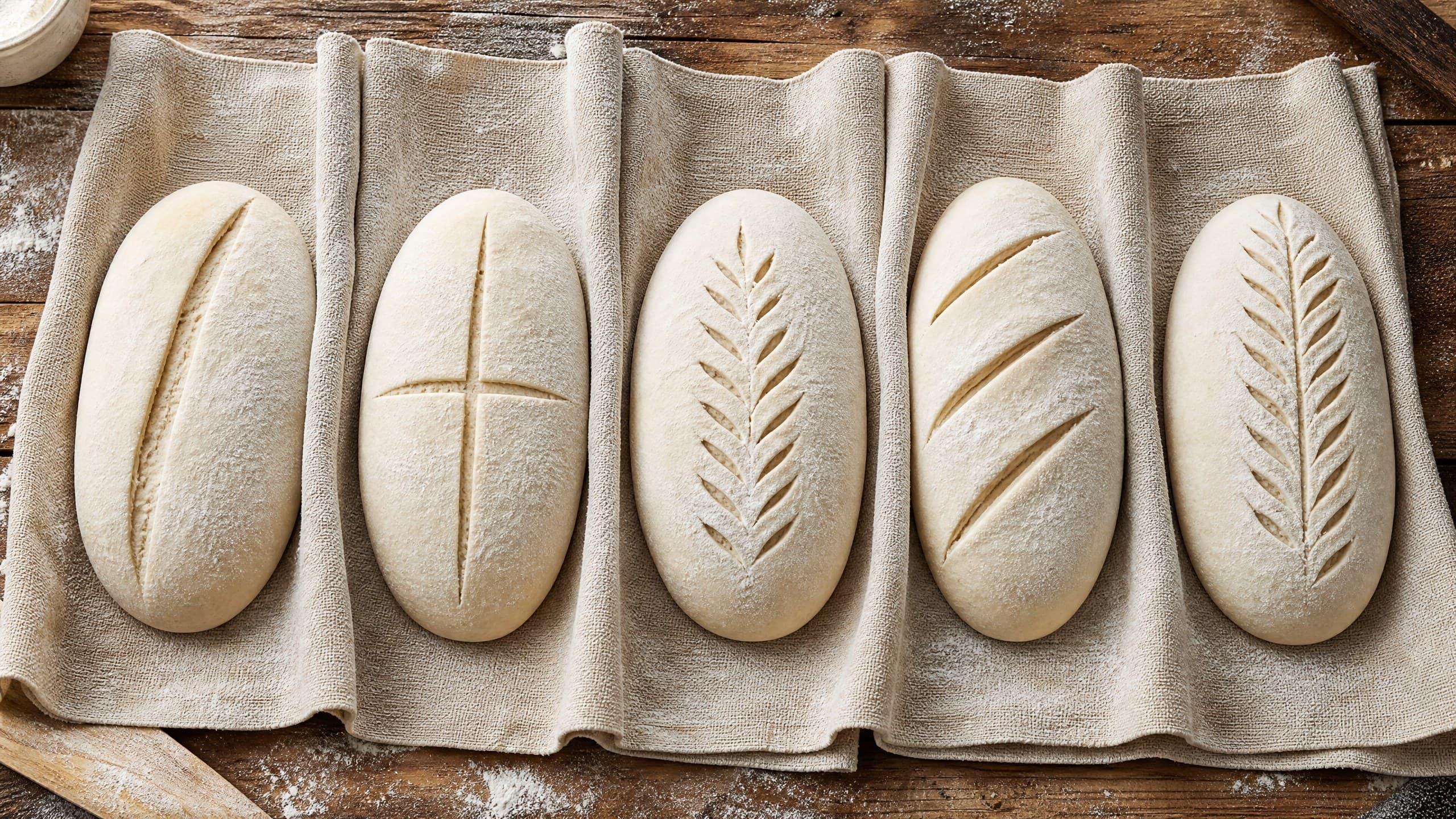
1. The single slash
The beginner's bread-and-butter. One long diagonal line across the top, ~1 cm deep at 45°. It opens cleanly into a classic look and teaches your hands the blade feel. Master this before anything else.
2. The cross
Two lines at right angles across the top. It's forgiving and gives the loaf a rustic, farmhouse split into four petals as it springs. Keep both cuts the same depth and angle.
3. The leaf
A central "vein" running down the loaf, then short angled cuts branching off each side like a leaf's ribs. The central cut gives height; the side cuts are shallower decoration. It reads as elegant without being hard — just steady hands and a chilled loaf.
4. The ear
The showpiece. Score a shallow, angled lip running along one edge of the boule, tilting the blade so it peels a flap of dough. As the loaf springs, that flap lifts into the ear. It's the same shallow-angle technique as the single slash, just placed at the rim and done with a lighter touch.
Tips for clean cuts
- Chill before you cut. 20–30 minutes in the fridge firms the skin for a glide, not a drag.
- Use a truly sharp blade. A dull edge tears; a fresh razor gives a clean wall.
- Don't second-guess. Commit to the stroke. Hesitation shows in the crust.
- Flour lightly first. A dusting of rice flour on the skin helps the blade travel and shows the cut clearly.
- Bake from cold. Straight from the fridge, the cut holds its shape until the oven sets it.
Troubleshooting blowouts
A blowout — the loaf splitting somewhere you didn't cut — usually means one of three things:
- Under-scored. The cut was too shallow or too short, so the skin re-sealed. Cut deeper and longer next time.
- Scored too late/warm. A warm, jiggly loaf is hard to cut cleanly. Chill it first.
- Over-proofed. A loaf proofed past its peak is fragile and erupts no matter how you score. Pull it into the oven a touch earlier.
Fix those three and blowouts mostly disappear.
Frequently asked questions
Why do you score sourdough bread?
Scoring gives the expanding gas a planned escape route. Without a cut, the loaf bursts at its weakest point — usually the side or bottom — instead of opening where you want. A good score controls the oven spring, shapes the open crumb and lets you grow an 'ear,' the lifted crust flap bakers chase. It's both function and signature.
What angle should the lame be when scoring?
A shallow angle of about 30–45° to the dough surface is the sweet spot. Too steep and you cut a deep vertical slit that collapses; too flat and you just graze the skin. The shallow angle is what peels up a flap of dough to form the ear as the loaf springs in the oven.
How deep should sourdough scoring be?
About 1 cm (½ in) for a typical boule. Too shallow and the skin re-seals and the loaf blows out elsewhere; too deep and the structure slumps and loses height. A cold, firm-skinned loaf makes hitting that depth cleanly much easier than a warm, wobbly one.
How do I stop my sourdough from blowing out?
Blowouts come from under-scoring or scoring too late on a warm loaf. Chill the proofed loaf 20–30 minutes so the skin tightens, score decisively to the right depth, and bake while it's still cold. Also check your proof: an over-proofed loaf is fragile and erupts no matter how you cut it.
What's the easiest sourdough scoring design for beginners?
The single diagonal slash. One clean line across the top of the boule, about 1 cm deep at a 45° angle. It reliably opens into a classic look and teaches you the blade feel before you move on to a cross, then the leaf and ear. Master the stroke, not the pattern, first.