100% Whole Wheat Sourdough Bread Recipe
This 100 whole wheat sourdough bread recipe uses 85% hydration and a long autolyse to fix the bran-cut crumb — an open, tender whole wheat loaf.
By Maya Ellison · Updated August 18, 2026 · 3 min read
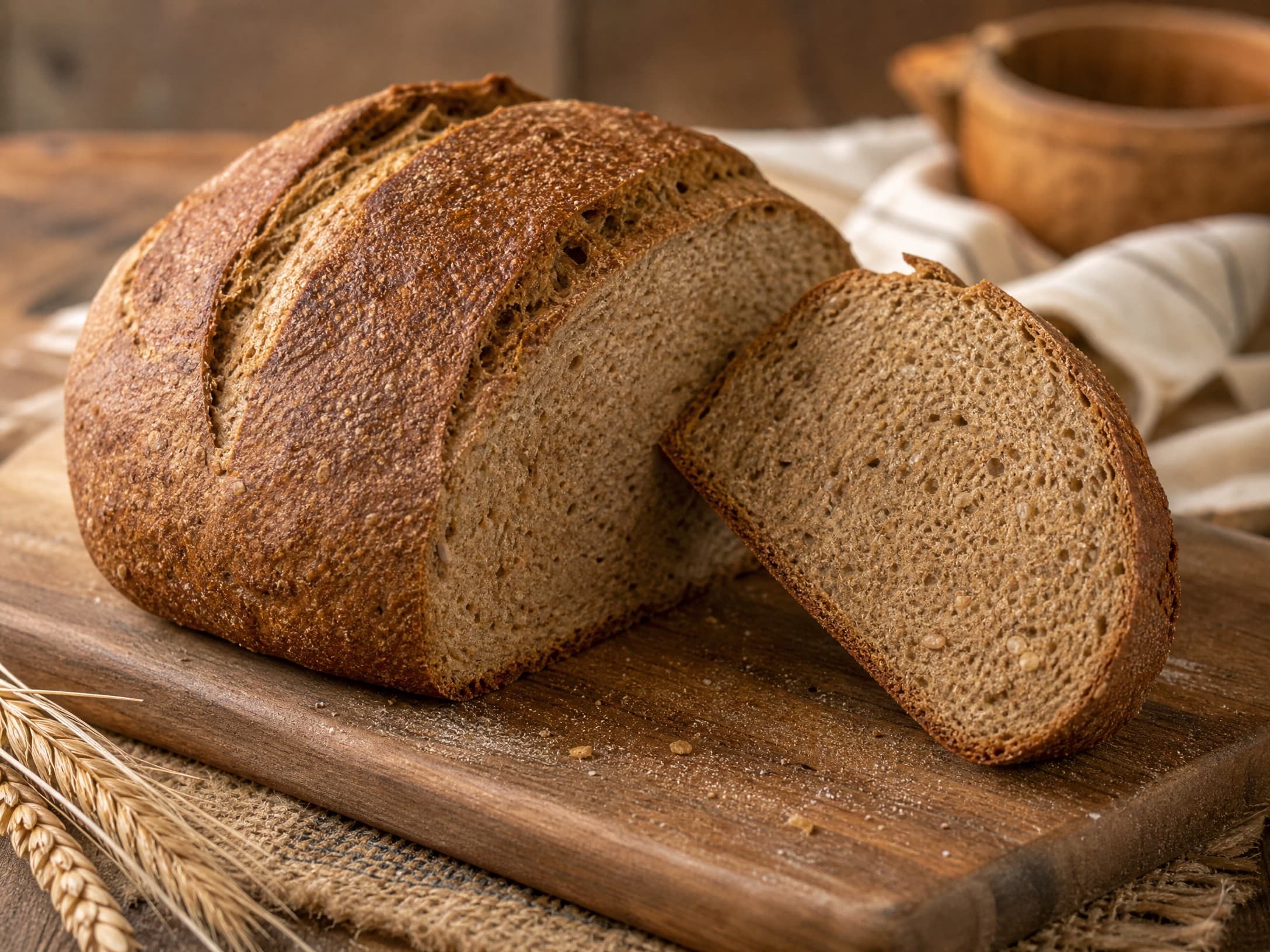
This 100 whole wheat sourdough bread recipe is the one I wish I'd had when I first tried whole-grain baking: a true 100% whole wheat loaf at 85% hydration, with a long autolyse and a patient fold schedule, that bakes into something open, tender, and honestly delicious — not the dense, bitter slab that gave whole wheat its reputation. The dough is a full 1 kg of flour, big enough for one impressive loaf or two modest ones. It's a hands-on recipe for the first couple of hours, then a matter of waiting for a 12-16 hour cold proof. If you're comfortable with the high-hydration guide, this is the next step up.
Why this recipe works
Every technique here exists to answer one problem: bran. Whole wheat flour is 100% of the grain, and the bran's sharp, fibrous particles physically cut gluten strands as the dough develops, like tiny scissors at a construction site. The result is the classic whole wheat failure — a loaf that refuses to rise and crumbles on the knife. This recipe fights back with three weapons: an 85% hydration that gives the gluten room to move around the bran, a 60-90 minute autolyse that softens the bran before fermentation begins, and six sets of folds to rebuild a gluten network the bran keeps damaging. None of it is magic. All of it is mechanics.
The bran-cut crumb, honestly
You should know what you're signing up for: 100% whole wheat will never have the spectacular open crumb of a white boule. What it can have is a moderately open, even, sliceable crumb that holds its shape and stays moist for days. The gap between "dense brick" and "good whole wheat" is huge, and this recipe closes most of it. The honest remainder — the slightly tighter texture, the deeper color, the faintly grassy aroma — is the entire point of baking with whole grain in the first place. Sky-high bubbles are a white bread virtue; this loaf has its own.
How the process is different
Watch the dough, not the clock. At 85% hydration, the dough starts shaggy and feels almost like a batter during the first folds — that's fine, it comes together by fold four or five. Use wet hands and a bench scraper rather than flouring boldly, which only encourages tearing. Bulk until the dough is genuinely aerated, 60% growth or more, even if that takes five hours; whole wheat ferments slower than white. And when shaping, be gentle to the point of reverence. The loaf proofing in the banneton is the shape you carry through to the end.
Swaps and variations
Scale the recipe to 70% whole wheat by swapping 300 g of bread flour into the mix — the result is far friendlier for beginners and still deeply whole grain. For a seeded version, fold 100 g of toasted sunflower or pumpkin seeds into the final folds. If your whole wheat is coarse stone-ground rather than fine, soak the flour for the full 90 minutes and expect several extra minutes of folds. The autolyse is your best friend in every variation; never skip it.
Storage
Whole wheat bread keeps better than white — the extra bran and fat content delay staling. Store cut-side down on the board for 3-4 days at room temperature, or in a bread box if you have one. It toasts beautifully and slices easily straight from the fridge. For longer keeping, slice and freeze in a sealed bag for up to 3 months; frozen slices go from freezer to toaster with no thawing dramatics. And if a loaf comes out denser than you'd like, make it bread crumbs — that's honest recycling, not failure.
Ingredients
Weights in grams are the source of truth; cup measures are approximate.
- 1000 g whole wheat flour (12-14% protein; freshly milled rises tallest)
- 400 g warm water (85-90°F), first pour
- 450 g warm water (85-90°F), second pour, added after the autolyse
- 200 g active sourdough starter (100% hydration)
- 22 g fine salt
- 15 g olive oil (optional — softens the crumb and tones down bran bitterness)
- 1 tbsp (15 g) honey (optional — rounds out whole wheat's bite)
- 50 g rice flour or extra whole wheat, for dusting the banneton
- Melted butter or olive oil, for brushing the crust after baking (optional)
Method
In a large bowl, combine the whole wheat flour with the first 400 g of warm water. Mix until no dry flour remains and rest, covered, for 60-90 minutes — the long autolyse is what softens the bran.
Add the starter, salt, and the second 450 g of warm water. Mix vigorously with a wet hand or dough scraper for 2-3 minutes. The dough will look rough — that's normal at this hydration.
Fold in the olive oil and honey if using, then rest the dough for 30 minutes, covered.
Begin the fold routine: 6 sets of stretch-and-folds, spaced 20-25 minutes apart. Whole wheat needs more folds than white dough — one clean stretch-and-fold per side each round.
After the first 3 folds, let the dough rest undisturbed for the remaining bulk. Target a total bulk of 4-5 hours at 78-80°F, until the dough has grown about 60% and feels aerated and pillowy.
Generously flour your work surface with whole wheat or rice flour. Be gentle: scrape the dough out and shape it with a bench scraper rather than stretching it — over-stretched whole wheat dough collapses.
Shape into a boule or batard with light, decisive movements, then seam-side up into a heavily floured banneton.
Cover and cold-proof for 12-16 hours in the fridge. For a same-day bake, proof 2-3 hours at room temperature until the dough springs back slowly when poked.
Place a Dutch oven or covered baker in the oven and preheat to 475°F for at least 45 minutes.
Turn the cold dough onto parchment, dust lightly, and score decisively — one confident slash about 1/2 inch deep. Whole wheat needs a deeper score than white dough.
Transfer to the hot Dutch oven, cover, and bake at 475°F for 25 minutes.
Remove the lid, reduce the oven to 450°F, and bake 25-30 minutes more, until the crust is deeply browned and the internal temperature reads 205-208°F.
Cool on a rack for at least 2 hours before slicing — an eager knife will crush the open crumb you worked for.
For a softer crust, brush the hot loaf with melted butter or olive oil the moment it comes out of the oven.
Frequently asked questions
Why is my 100% whole wheat bread so dense?
Almost always under-built gluten: the bran physically slices gluten strands as they form, so whole wheat dough needs more folds and more bulk time than white dough. Follow the 6-set fold routine and bulk until the dough is genuinely airy, not just 'bigger.' And be ruthless on the autolyse — it's the single biggest density fix.
Why does my whole wheat loaf taste bitter?
Whole wheat flavor is a spectrum from nutty to bitter, and bitterness comes from the bran being either over-worked or under-fermented. Long autolyse, a longer cold proof, and a dark bake all tame it. The optional honey is a fair remedy too — 15 g is enough to round the edge without making the bread sweet.
Can I add fat like butter or oil?
Yes, and it helps: 15 g of oil adds tenderness and softens the bran's harshness. Keep it modest at 1-2% of flour weight — beyond that, whole wheat dough gets slippery and refuses to hold gas. Butter added in the autolyse works, but olive oil at the mixing stage is simpler and just as good.
How do I adjust the hydration for my flour?
This recipe assumes a standard 12-14% protein whole wheat. Mill your own? Expect to need 20-40 g more water. Use a heavy stone-ground flour? Pull back 20-30 g. The dough should feel tacky but not gluey, and after folding it should release from the bowl in a soft sheet, not a puddle.
Is this a good first sourdough recipe?
No — be honest with yourself. 100% whole wheat at 85% hydration is an advanced bake, and blaming your technique while your starter is still new is a recipe for quitting. Start with the [basic sourdough bread recipe](/sourdough-bread-recipe), keep your [starter](/sourdough-starter) healthy, then come back here. The beginner-friendly path is 50-70% whole wheat.