80 Hydration Sourdough Recipe: A Complete Guide
An 80 hydration sourdough recipe in grams, with handling techniques, folding and troubleshooting that turn a sticky blob into an open crumb.
By Maya Ellison · Reviewed by Maya Ellison · Updated August 18, 2026 · 6 min read
Quick answer
The open, airy crumb with holes the size of coins is what pulls most bakers toward an 80 hydration sourdough recipe. It's also where beginners go wrong — not because the hydration is impossible, but because the handling is different. This guide covers what high hydration sourdough changes in your dough, how to handle it and when to walk away and try again later.
What hydration means
Hydration is the ratio of water to flour, by weight: water ÷ flour × 100. Five hundred grams of flour with 400 g of water is an 80% hydration dough. Four hundred grams of water with 500 g of flour is also 80% — the math is the same in either order. Starter counts toward hydration too (it's half flour, half water), which is why two recipes with the same hydration can feel different. The baker's percentages guide explains the full math if you want to decode any recipe on the internet.
The 80 hydration sourdough recipe in grams
Here's the recipe in full — one loaf, about 1,000 g of dough:
- 450 g bread flour
- 50 g whole wheat flour
- 400 g water, at 80°F (27°C)
- 100 g active starter (at peak)
- 10 g fine salt
The method:
- Autolyse (45 minutes). Mix the flours and 350 g of the water until no dry bits remain. Cover and rest.
- Add starter (15 minutes). Spread the starter over the dough, add the remaining 50 g of water and squeeze and fold until the starter is fully incorporated.
- Add salt (10 minutes). Sprinkle the salt over the dough and work it in with wet hands. The dough will tear at first — keep going gently until it comes together.
- Coil folds (4–5 rounds, 30 minutes apart). Every half hour, wet your hands, lift the dough from the middle and tuck the ends underneath. This builds structure without degassing the dough.
- Bulk ferment (4–5 hours at 76–78°F / 24–26°C). The dough should grow 70–80% and jiggle when you shake the bowl. Watch the dough, not the clock.
- Pre-shape (5 minutes). Tip the dough onto a lightly floured counter with a wet bench scraper, round it gently and rest 25 minutes.
- Shape (5 minutes). Flour your hands lightly, round the dough again and place it seam-up in a well-floured banneton or bowl.
- Proof (60–90 minutes). Room-temperature proof until puffy and slightly domed.
- Bake (45 minutes). Covered at 475°F (245°C) for 20 minutes, then uncovered at 450°F (230°C) for 25 minutes, until deep brown.
What changes at 80% hydration
Compared to a 70–75% dough, four things shift:
- Open crumb. The extra water lets gas expand into bigger pockets — that's the look you're chasing.
- Longer bulk. More water slows the microbes, so expect 4–5 hours instead of 3.
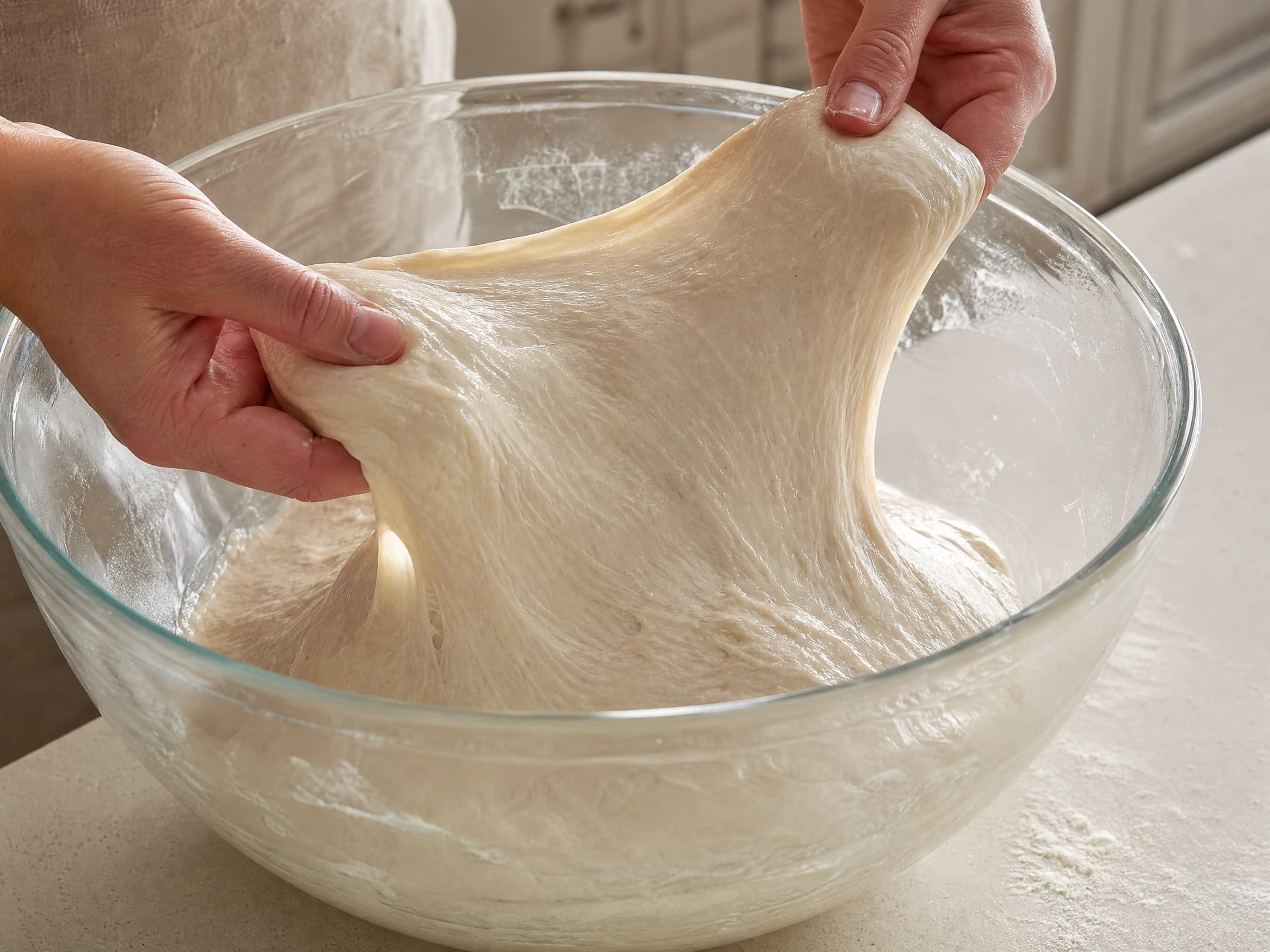
- Stickier handling. The dough wants to attach to everything. This is normal and manageable.
- More oven spring. A properly fermented high-hydration loaf blooms in the oven — the reward for the sticky middle of the process.
High hydration dough handling
High hydration dough handling is a different skill and it's learnable in one bake:
- Wet hands, not floured. Water is the better anti-stick agent. Keep a small bowl of water beside you and dip between every touch.
- Coil folds over stretch-and-folds. Coils build strength with less tearing and barely deflate the dough.
- A wet bench scraper is the third hand you didn't know you needed — it lifts and folds dough that fingers would shred.
- Work in the bowl. For the first hours, do all the folding in the mixing bowl. The counter can wait until shaping.
- Don't add flour. A dusting for shaping is fine, but adding flour to the bulk is how a high-hydration recipe quietly becomes a medium-hydration one.
- A damp towel under the bowl keeps things from sliding as you fold.
The shaping bread dough guide covers the final shape in more depth — at 80%, gentle is the whole game.
When not to start here
Walk away from 80% if any of these describe you:
- It's your first or second loaf. Start at 70–75%; the classic sourdough bread recipe is written for exactly that.
- Your starter doubles in more than 6 hours. A weak starter can't hold up an 80% dough — the crumb collapses into pudding.
- Your kitchen runs cold. Below 72°F (22°C), a high-hydration bulk becomes an all-day event.
- You're baking without a scale. Hydration is pure ratio math; eyeballing it never works.
There's no shame in 70%. The skills you learn there — reading the dough, timing the folds — are exactly the skills 80% demands.
Troubleshooting the gluey blob
Your dough turned into a puddle. First instinct: add flour gradually. That's cheating — it silently lowers your hydration, teaches you nothing and you'll never actually bake an 80% loaf. Instead, work through the real causes in order:
- Is the starter strong? If it wasn't at peak, the dough never had a chance. Next time, build the starter and use it at the dome.
- Is the bulk long enough? An 80% dough that's only risen 30% looks like a blob and handles like one. Give it another hour before touching it.
- Is it over-bulked? The flip side: a dough that's risen past 100% loses all structure and turns into glue. Catch it at 70–80%.
- Is the dough warm enough? Cold dough never develops. Check for a warm spot.
- Are your hands wet? If you're touching the dough with dry hands, you're tearing the gluten and the dough fights back.
And the emergency escape hatch: put the bowl in the fridge for 20 minutes. Chilled dough tightens up just enough to shape.
Hydration levels at a glance
| Hydration | Dough feel | Crumb | Who it's for |
|---|---|---|---|
| 65% | Stiff, easy to handle | Tight, even | First loaves, sandwich bread |
| 70% | Slightly tacky | Moderate | Weekly baking, beginners |
| 75% | Soft, manageable | Open, soft | Most home bakers |
| 80% | Sticky, slack | Open, large holes | Experienced bakers |
| 85–90% | Batter-like | Very open, fragile | Enthusiasts with strong starters |
The jump from 75% to 80% is the biggest one you'll feel. Take it when your starter is strong, your kitchen is warm and you have a bench scraper within reach — then enjoy the first slice of what all the fuss was about.
Frequently asked questions
Is 80% hydration good for sourdough?
Yes, for the right baker. It produces the open, airy crumb most sourdough bakers are chasing, with larger holes and a delicate texture. But it demands a strong starter, warm bulk conditions and gentle handling. If you've baked fewer than five loaves, 70–75% will teach you the same skills with far less frustration.
Why is my high hydration dough a sticky blob?
Usually one of three things: a starter that's not strong enough, a bulk ferment that ended too early, or dough that hasn't been folded enough to build structure. Time and folds are the fix, not flour — add 30–60 minutes of bulk and two more coil folds before deciding anything is wrong.
What hydration should a beginner use?
Start at 70–75%. That range is wet enough to learn folds and shaping, dry enough that mistakes don't stick to your hands. Move to 80% after you can consistently read when a 75% dough is ready. The jump is small on paper and large in feel.
Do I need a mixer for high hydration dough?
No. Hands, a bowl and a bench scraper are the entire toolkit. Coil folds and time develop the gluten; a mixer just speeds it up. Wet hands are your most important tool — they keep a sticky dough from becoming a mess and they're always with you.
How long does an 80% hydration dough take to bulk ferment?
At 76–78°F (24–26°C), plan on 4–5 hours, compared to 3–4 at 75% hydration. The extra water slows fermentation and the open crumb you're after only appears when the bulk runs long enough. Judge by growth — 70–80% larger and jiggly — not by the clock.