Sourdough Ciabatta Rolls: Big Holes, Olive Oil, No Knead
High-hydration sourdough ciabatta rolls with open crumb and a hit of olive oil: 420 g water, 100 g starter, 100% hydration, folded not kneaded, baked into 8 floury slipper-shaped rolls.
By Maya Ellison · Reviewed by Maya Ellison · Updated August 29, 2026 · 3 min read
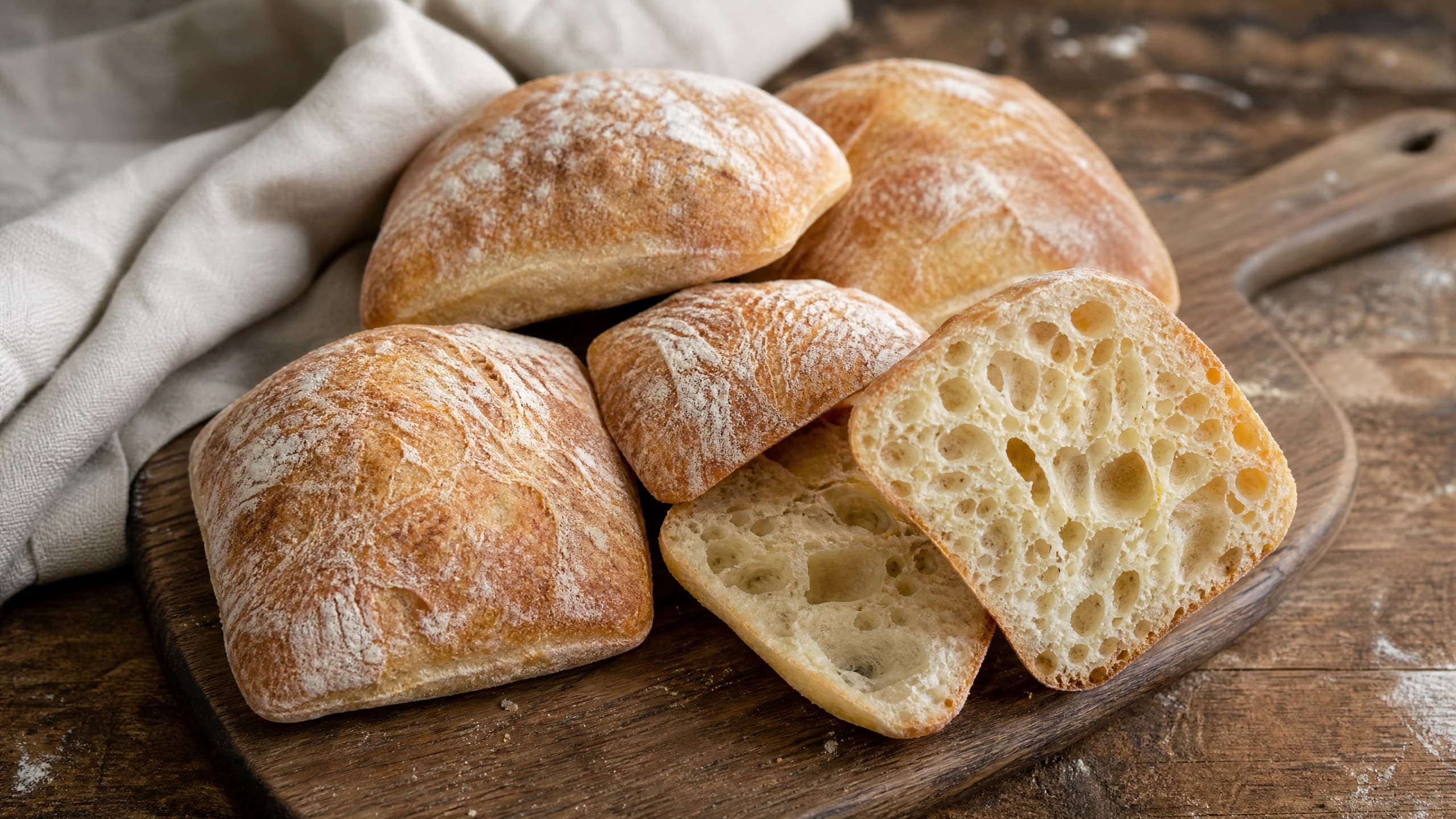
Sourdough ciabatta rolls are the easiest way to get a bakery-open crumb at home: a 100% hydration dough of 420 g flour, 420 g water, 100 g starter, olive oil and salt, folded (never kneaded) into 8 floury, slipper-shaped rolls with big holes and a chewy, golden crust. They're wet, yes, but the reward is a crumb you can see through.
Why this recipe works
Ciabatta means "slipper" in Italian, named for the flat, slab shape. The secret is hydration at or near 100% — so much water that the dough is closer to a thick batter than a ball. You build strength with coil folds instead of kneading, which keeps the gas pockets intact instead of punching them out.
| Ingredient | Percentage | Weight (this recipe) |
|---|---|---|
| Bread flour | 100% | 420 g |
| Water | 100% | 420 g |
| Active starter | 24% | 100 g |
| Olive oil | 7% | 30 g |
| Salt | 2.4% | 10 g |
That olive oil is what separates ciabatta from a plain high-hydration loaf: it tenderizes the crumb and gives the crust its characteristic chew.
The stages, in order
The mix is loose on purpose. Don't fight it by adding flour — a stiff ciabatta is just a roll-shaped loaf with no holes. If the batter feels unworkable, wait 30 minutes; the flour hydrates and the dough firms up enough to fold.
Coil folds are your only "kneading." Four rounds, 30 minutes apart, lift and fold the slack dough over itself. You're building a weak gluten net that can trap huge bubbles without tearing.
Bulk fermentation is short and warm. This wet dough ferments faster than a 75% loaf, so check it at 3 hours: you want puff, jiggle and surface bubbles, not a doubled, domed dome.
Shaping is gentle. Cut, coax into ovals, and stop. The more you handle, the fewer holes you get.
Baking with steam opens the crumb. A pan of hot water on the oven floor for the first 15 minutes keeps the crust flexible so the rolls can spread and spring.
Common mistakes (and the fix)
- Tight, bready crumb: dough too dry or over-handled. Keep water at 100% and treat the folds gently.
- Tear-from-the-bench disaster: surface too dry. Wet your hands and scraper; let the dough tell you when it releases.
- Pale, soft crust: not enough steam or oven too cool. Add the water pan and verify 475°F (245°C) with a thermometer.
- Rolls merge into one slab: spaced too close or over-proofed. Give each oval room and watch the clock on the final proof.
Serving ideas
Split and toast for panini, soak up soup, or pile with prosciutto and tomato. The open crumb is built to hold olive oil and dips. Want more high-hydration practice? The high-hydration sourdough guide explains how to handle wet dough safely, and the beginner's guide to sourdough covers the fundamentals.
Before you bake
This recipe assumes an active sourdough starter. If yours needs building back up, the sourdough starter guide will get it to peak before you start. Keep the dough poke test handy for the final proof, and when things go sideways the sourdough troubleshooting hub has the fix.
Ingredients
Weights in grams are the source of truth; cup measures are approximate.
- 420 g bread flour (about 3 1/3 cups)
- 420 g water at 80-85°F / 27-29°C (about 1 3/4 cups), plus 20 g for the starter mix
- 100 g active sourdough starter (about 1/3 cup), fed to peak
- 30 g extra-virgin olive oil (about 2 tablespoons), plus more for the pans
- 10 g fine sea salt (about 2 teaspoons)
Method
Mix: combine the bread flour, 420 g water, active starter and olive oil in a large bowl. Squish with your hand until no dry flour remains. The dough will be a loose, sticky batter — that is correct for ciabatta.
Add salt and rest: sprinkle the salt over the dough and pinch it in. Cover and rest 30 minutes at room temperature to let the flour fully hydrate.
Coil fold: with wet hands, grab one side of the dough, lift and fold it over the center, then rotate the bowl and repeat until you've gone all the way around. Do this 4 times, 30 minutes apart, over the first 2 hours.
Bulk ferment: leave the covered dough at 74-78°F (23-26°C) until it is puffy, jiggly and dotted with bubbles, about 3-4 hours. High hydration dough rises faster than a stiff loaf, so watch it, not the clock.
Prepare pans: line two baking sheets with parchment and brush lightly with olive oil. Dust the parchment with a thin layer of flour or semolina so the wet dough releases cleanly.
Shape: turn the dough onto a well-floured surface and divide into 8 equal pieces with a bench scraper, handling them as little as possible. Gently coax each into a flat, slipper-shaped oval and place on the prepared pans.
Proof: cover loosely and proof at room temperature 45-60 minutes, until the rolls look airy and a poke slowly springs back. They should spread, not hold a tight shape.
Bake: preheat the oven to 475°F (245°C) with a pan of hot water on the floor for steam. Bake the rolls 22-25 minutes until deep golden and crusty. Cool on a rack at least 1 hour before splitting.
Frequently asked questions
Why are my ciabatta rolls flat instead of holey?
Flat rolls are usually under-proofed or over-handled. Let the bulk ferment run until the dough is genuinely jiggly and bubbly, then handle the pieces as little as possible when shaping — the air you knock out is the air you want in the crumb.
Do ciabatta rolls need a Dutch oven?
No. Ciabatta bakes open on a sheet pan with steam from a pan of hot water on the oven floor. The steam keeps the crust soft long enough for the rolls to spring and open up their holes before setting.
Can I make ciabatta rolls with all-purpose flour?
You can, but bread flour's higher protein is what holds the wide, open crumb together at 100% hydration. With all-purpose, pull the water back to about 380 g and expect a slightly tighter crumb.
Why add olive oil to ciabatta?
Traditional ciabatta includes olive oil for a softer crumb, richer flavor and a more pliable dough that's easier to handle at high hydration. It also helps the crust stay chewy rather than rock-hard.