8 Hour Sourdough Bread Recipe: Same Day, Mix to Oven
An 8 hour sourdough bread recipe that goes from mixing to baked in one day: warm water, a tight timeline and what you trade for speed.
By Maya Ellison · Reviewed by Maya Ellison · Updated August 18, 2026 · 5 min read
Quick answer
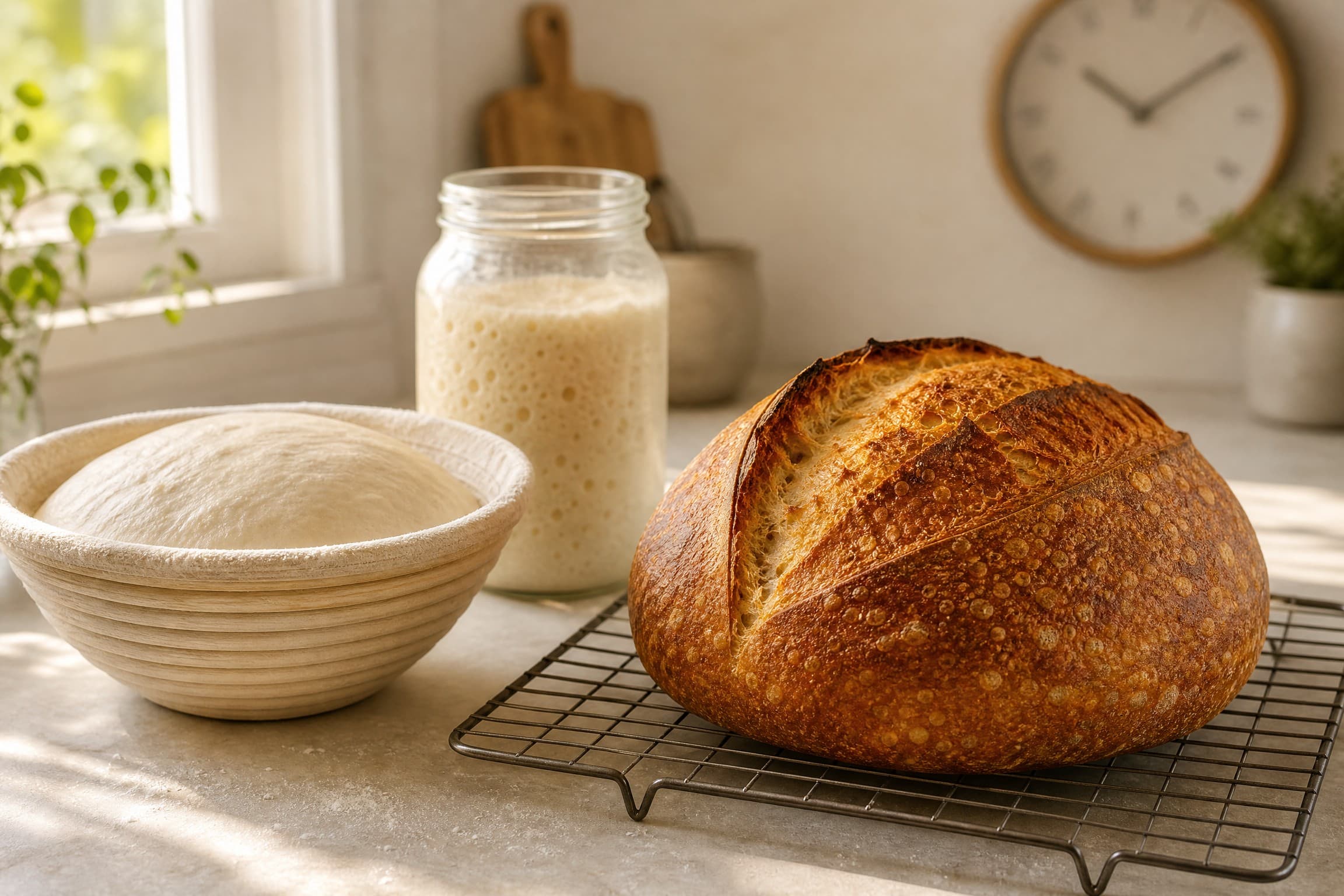
You can go from a jar of starter to a sliced loaf in about 8 hours. It won't be the tangiest or the most open-crumbed bread you've ever made — but it will be real sourdough, baked the same day you mixed it. This 8 hour sourdough bread recipe is the schedule I use when I wake up and want bread for dinner.
The same day sourdough bread schedule
Everything hinges on warmth. The same day sourdough bread schedule below assumes a mature starter, a warm spot for the dough and a kitchen at 72–78°F (22–26°C).
| Time | Step |
|---|---|
| 7:00 a.m. | Feed the starter: 20 g starter + 40 g flour + 40 g water at 85°F (29°C). Keep it warm. |
| 9:30 a.m. | Mix the dough with warm water — target dough temperature 78–80°F (26–27°C). |
| 10:00 a.m. | Autolyse complete. Add starter and salt. |
| 10:00 a.m. – 12:00 p.m. | Bulk ferment at 78°F (26°C): 3–4 folds in the first 2 hours. |
| 12:30 p.m. | Pre-shape; rest 20 minutes; final shape. |
| 12:50 – 1:50 p.m. | Proof 45–60 minutes at room temperature. |
| 1:20 p.m. | Preheat the Dutch oven at 475°F (245°C). |
| 1:50 p.m. | Score and bake: 20 minutes covered, 20–25 minutes uncovered. |
| 4:15 p.m. | Slice — after the 2-hour cool. |
That's 8 hours from the first feeding to a finished loaf, with about 45 minutes of actual hands-on work.
The recipe behind the schedule:
- 400 g bread flour
- 300 g water (temperature as needed — see the FAQ)
- 80 g starter (fed that morning, at peak)
- 8 g fine salt
What you trade for speed
Speed is a trade and you should know exactly what you're spending:
- Less tang. The acids that make sourdough sour build over hours. An 8-hour loaf tastes mild and fresh, more like yeasted artisan bread.
- A tighter crumb. Less fermentation time means less gas for the gluten to trap, so the holes are smaller and more even.
- A shorter error window. Everything happens fast, so a cold draft or a sleepy starter shows up immediately. This is not the recipe for a distracted day.
What you keep is the good stuff: the crust, the texture, the fermentation — and bread on the same day you thought of it.
Keeping a fast sourdough recipe reliable
A fast sourdough recipe is only reliable when three things cooperate and you can control all three:
- A warm spot, 78–80°F (26–27°C). The oven with just the light on, the top of the fridge, or the spot next to the router. Every degree below 75°F (24°C) adds meaningful time to the bulk.
- Starter at its peak. Feed it early, keep it warm and use it the moment it domes. Starter past its peak is the quiet killer of same-day bread.
- Water temperature. Mix with water at 85–95°F (29–35°C) so the dough lands at 78–80°F (26–27°C). A thermometer here is worth its weight in crust. The dough temperature guide explains the full math.
Building the 8-hour loaf, step by step
7:00 — Feed the starter. Use the 1:2:2 ratio (20 g starter, 40 g flour, 40 g water) so it peaks in 4–5 hours instead of 6. Keep it at 80°F (27°C) — in the warm spot you've already chosen.
9:30 — Mix. Stir the flour and warm water together until no dry flour remains. It will be a shaggy mass. Cover and rest 30 minutes.
10:00 — Add starter and salt. Spread the starter over the dough, add the salt and squeeze and fold with wet hands for 4–5 minutes until the dough tightens. It won't be silky — that's fine.
10:00 – 12:00 — Bulk ferment. Leave the dough in its warm spot and do 3–4 folds at 30-minute intervals for the first 2 hours. After the folds, let it sit until the dough is puffy, domed and about 60–70% larger. At 78°F (26°C) that's roughly 3–3.5 hours total. The proofing bread dough guide has the visual cues.
12:30 — Shape. Tip the dough onto a lightly floured counter, round it into a tight ball and let it rest 20 minutes. Shape again and place it seam-up in a floured bowl or banneton.
12:50 – 1:50 — Proof. At room temperature, 45–60 minutes is enough — the dough should look puffy and jiggly. Finger-poke test: it should spring back slowly, leaving a small dimple. If it snaps back instantly, it needs more time; if it doesn't spring back at all, bake it now.
1:50 — Bake. Score the dough about 1/4 inch deep, bake covered at 475°F (245°C) for 20 minutes, then uncovered at 450°F (230°C) for 20–25 minutes, until the crust is deep brown. Internal temperature of 205°F (96°C) confirms it's done — the easiest check if you own a thermometer.
4:15 — Slice. After two full hours of cooling. I know. It's worth it.
When the schedule slips
The schedule is a map, not a contract. Missed a fold? Skip it and move on — the bulk will still finish. Kitchen cold? Move the dough to the oven with the light on and add 30–60 minutes of bulk. Starter slow? Extend the bulk until the dough is genuinely puffy; bread can wait for dinner, but a half-proofed loaf can't be fixed after baking. And if the dough is still clearly underproofed when the oven is ready, just let it keep proofing — same-day bread can still be evening bread.
Frequently asked questions
Is 8 hours enough time to ferment sourdough bread?
Yes, with the right conditions. A mature starter at peak, dough kept at 78–80°F (26–27°C) and a 15–20% starter inoculation speed fermentation dramatically. You'll get a mildly tangy, well-risen loaf. If the kitchen is cold or the starter is young, the same recipe needs 10–12 hours.
Will same-day sourdough taste as sour as an overnight loaf?
No. Sourness comes from acids that need hours to develop, so an 8-hour loaf tastes mild and wheaty, closer to a yeasted artisan bread. If you want real tang, the answer is a cold proof: shape in the evening, refrigerate 12–24 hours and bake the next day — just no longer same-day.
What water temperature should I use?
Target the dough, not the water: you want 78–80°F (26–27°C) dough after mixing. In a 70°F (21°C) kitchen, that means water around 85–95°F (29–35°C). Mix, check with a thermometer and adjust next time — warm flour and a warm kitchen both raise the final temperature.
Can I make same-day sourdough with a young starter?
You can, but the timeline gets unreliable. A young starter that takes 8+ hours to double will stretch the whole schedule past dinner. Use a starter that doubles in 4–6 hours and bump the inoculation to 20% of the flour weight for a reliable 8-hour bake.
Why didn't my 8 hour loaf rise much?
The two usual suspects: dough that was too cold, or starter past its peak. Cold dough fermenting at 68°F (20°C) won't finish in 3.5 hours of bulk and starter used after it collapsed adds little gas. Check dough temperature with a thermometer and feed the starter so it peaks right when you mix.