Hydration in Sourdough: Percentages Explained
What hydration means in sourdough, how to calculate it, and how the percentage changes crumb, crust, handling and proofing time.
By Maya Ellison · Reviewed by Maya Ellison · Updated August 30, 2026 · 5 min read
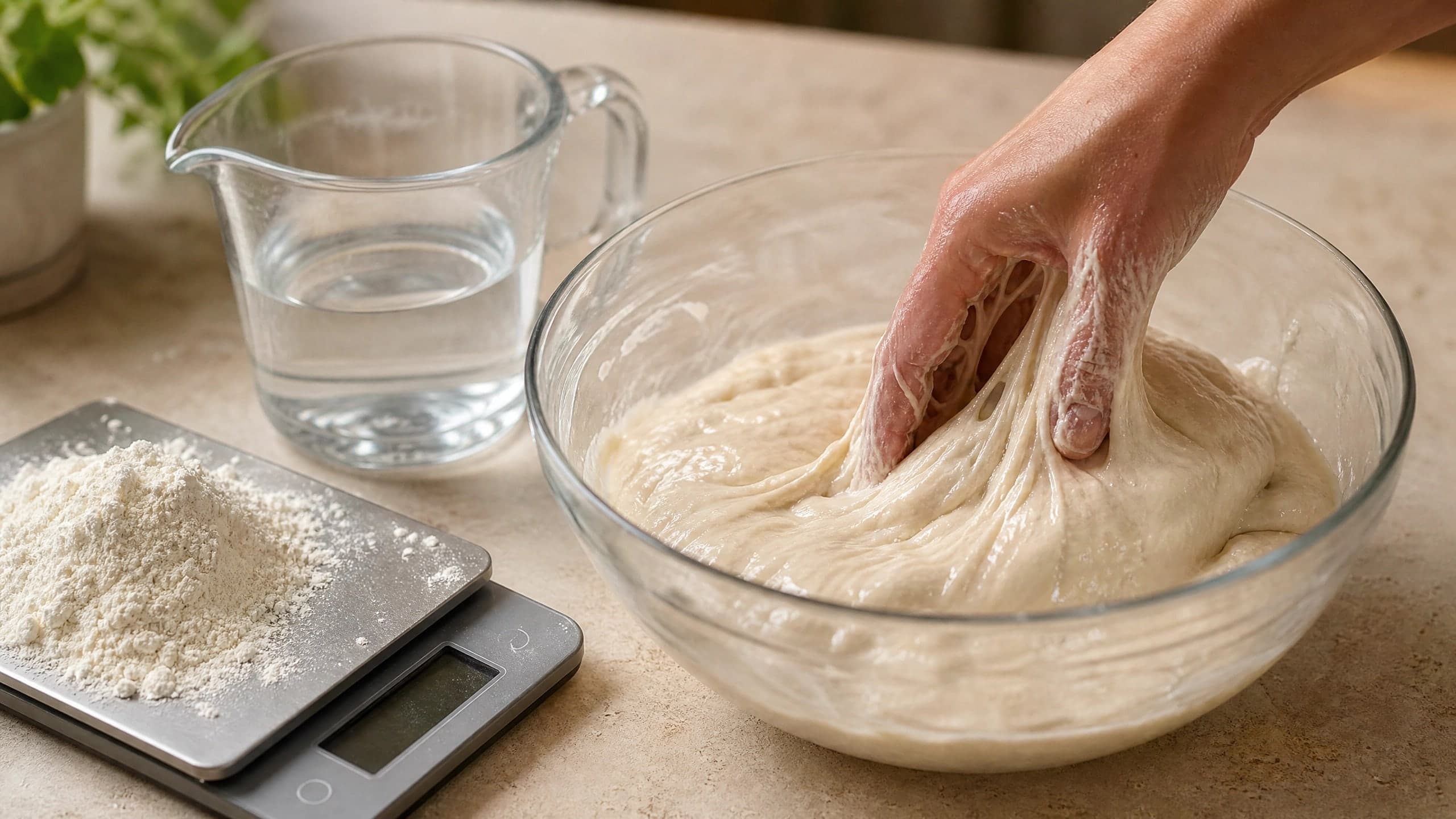
Quick answer
Every sourdough recipe hides its most important number in plain sight: the hydration. It tells you whether the dough will feel like putty or batter, whether the crumb will be tight or open, and how long the bake will go. It is also the one number you can change deliberately — by grams — to make a loaf crunchier, softer, easier or showier. This guide explains what hydration actually is, how to calculate it, and what each percentage does to your bread.
What hydration means
Hydration is the weight of water compared to the weight of flour, written as a percentage:
water (g) ÷ flour (g) × 100 = hydration %
A dough made with 350 g of water and 500 g of flour is a 70% hydration dough. The same math works backwards — both the chocolate bread recipe and the naan recipe lean on it to explain why their doughs behave the way they do. Once you read hydration, every recipe on the internet decodes into one number: wet, medium or dry.
Hydration only makes sense in grams. A measuring cup of flour can weigh 15% more or less depending on how it's scooped, which silently rewrites the hydration you think you're baking. Weigh everything.
How to calculate hydration
The plain version: divide water by flour and multiply by 100.
- 500 g flour + 350 g water = 70%
- 500 g flour + 375 g water = 75%
- 500 g flour + 400 g water = 80%
Counting the starter. If your recipe is written in percentages, the levain counts too. A 100 g starter at 100% hydration is 50 g flour and 50 g water, so a formula with 500 g flour, 350 g water and that starter is really 550 g flour and 400 g water — about 73%, not 70%. Recipes that ignore the starter's contribution usually say so; the full baker's percentage method, including this adjustment, lives in the baker's percentages guide.
What each hydration level does
| Hydration | Dough feel | Crumb | Best for |
|---|---|---|---|
| 60–65% | Stiff, holds its shape | Tight, even | Sandwich loaves, shaping practice |
| 70% | Soft but not sticky | Moderate, easy | Beginners, weeknight bakes, enriched doughs |
| 75% | Supple, slightly tacky | Open, airy | Most home bakers, daily loaves |
| 80% | Slack, clingy | Large holes | Experienced bakers, open crumb |
| 85%+ | Batter-like, fragile | Very open, thin walls | Enthusiasts with strong starters |
The step that matters most is 70% → 75%: that is the jump where the dough starts to flow, needs folding to hold its shape and rewards a confident hand. Beyond 80%, handling technique becomes the whole game — see the high hydration sourdough guide for the full method.
How hydration changes a loaf
- Crumb. More water, bigger holes — up to the point where the structure can't hold and the crumb goes flat and dense instead. 75% is where the open-crumb look becomes achievable for most bakers.
- Crust. Wet doughs ferment more slowly and produce more steam, which usually means a thinner, crisper, browner crust. Dry doughs bake thicker and dare to stay blonde.
- Handling. Each 5% changes the feel dramatically. 65% doughs behave close to playdough; 80% doughs need wet hands, a bench scraper and patience. This is why a recipe tells you its hydration before its ingredient list.
- Proofing. More water slows fermentation — 80% hydrations bulk for noticeably longer than 70% ones. Drier doughs rise faster but tighten faster too.
- Whole grain. Whole wheat and rye absorb more water than white flour, so a "70%" whole-grain dough feels like a 60% white dough. Keeping the feel you like usually means raising the percentage when you swap in whole grain.
Choosing the right hydration
Pick the number by what you're baking and how sure your hands are:
- First loaves: 70%. Forgiving to shape, impossible to lose. The classic sourdough bread recipe is written at 75%; drop back to 70% if it feels like too much.
- Daily bread: 70–75%. The band most home bakers live in — enough character for the table, easy enough for a Tuesday.
- Enriched and tender loaves: 70%. Chocolate, spice or butter loaves already soften the crumb, so they stay at 70% to keep their shape.
- Show loaf: 75–80%. When you want the holes and the ear, move up one rung at a time.
- Pasta and flatbreads: 50–65%. Doughs worked on a bench, rolled or slapped, can't be soaking wet — the sourdough pasta guide runs at the dry end of the scale on purpose.
How to change hydration in a recipe
Small, measurable changes — never "a splash":
- Convert the recipe: water ÷ flour × 100.
- Decide the target level (see the table above).
- Move the number in grams: on a 500 g flour base, every 5% is 25 g of water.
- Add the water in the mix, not later — late water makes the dough hard to handle.
- Expect the downstream shifts: wetter doughs proof a little longer and fold a little easier, and the proofing guide keeps the timing honest.
Start with the classic sourdough bread recipe, dial the percentage up or down by one step, and compare the two loaves side by side. That single experiment teaches more about hydration than any chart.
References
- King Arthur Baking — hydration and baker's percentage resources: kingarthurbaking.com — test kitchen documentation on hydration ratios and flour absorption.
- Reinhart, P. (2001). The Bread Baker's Apprentice. Ten Speed Press — the standard treatment of baker's percentages and hydration in formula-based baking.
- Calvel, R. (2001). The Taste of Bread. Aspen Publishers — on how hydration and mixing interact with the crumb and crust of fermented doughs.
Frequently asked questions
What is 70% hydration sourdough?
A dough made with 70 g of water for every 100 g of flour — for example 350 g water and 500 g flour. At 70% the dough is soft but stays workable, doesn't glue itself to your hands and shapes without much practice. It's the sweet spot for most home bakers and for enriched loaves like chocolate bread, where the fat in the mix already softens the crumb.
How do I calculate sourdough hydration?
Divide total water by total flour, in grams, and multiply by 100. 400 g of water and 500 g of flour is 80% hydration. If your starter is part of the bill, count its flour and water too: a 100 g starter at 100% hydration adds 50 g flour and 50 g water. The [baker's percentages guide](/guides/bakers-percentages) walks through the full math.
What is a good hydration for sourdough?
70–75% for most home bakers: wet enough for an open, airy crumb and dry enough to shape without a fight. Beginners should start at 70% and stay there until the dough reads consistently. Go above 80% only when the starter is strong and you're chasing the open, holey crumb — that's the territory of the [high hydration guide](/guides/high-hydration-sourdough).
Does higher hydration mean a more open crumb?
Usually yes, up to a point. More water lets the gas expand into bigger pockets and gives the oven spring more room, so 75–80% doughs bake with visibly larger holes than 65% ones. But the open crumb only appears if fermentation and folds keep up with the slackness — a high-hydration dough that is under-proofed or under-folded just collapses into a dense, flat loaf.
Why does my dough feel wet even though the hydration isn't high?
Because hydration is a ratio, not a feeling. Different flours absorb different amounts of water: a whole wheat flour at the same 70% will feel drier than an all-purpose flour, and a damp or rainy day changes how the flour behaves. Judge wetness when baking, but always write the recipe in percentages so it repeats.
How do I change the hydration of a recipe?
Adjust the water in grams and leave the flour unchanged. To go from 70% to 75% on a 500 g flour recipe, add 25 g of water (350 g → 375 g). Each percent is 5 g of water on that base. Then expect the dough to feel wetter, proof a little longer and need gentler folds — the [dough temperature guide](/guides/dough-temperature) helps keep the pace predictable.