Sourdough Discard Crackers Recipe
Crispy sourdough discard crackers recipes for thin, seedy crackers made with 150 g of unfed discard — 5 ingredients and a slow bake.
By Maya Ellison · Reviewed by Maya Ellison · Updated August 18, 2026 · 2 min read
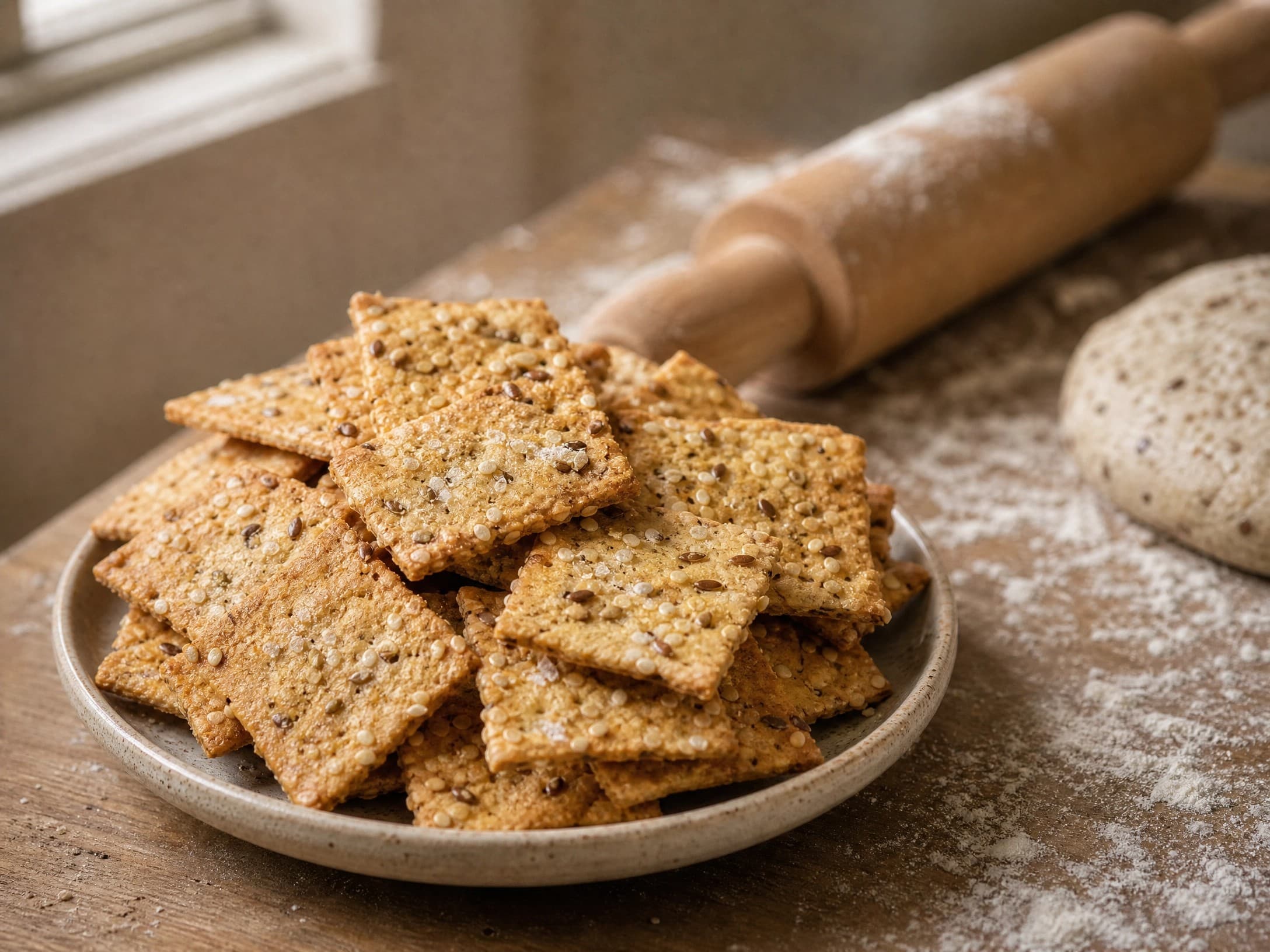
Sourdough discard crackers recipes are the highest-value use for an overflowing fridge jar: this one turns 150 g of unfed discard into a batch of thin, seedy crackers that snap cleanly in two. Five ingredients, no special equipment and a long, slow bake at a low temperature — the method is forgiving, the finished crackers look like something from a specialty shop and the active work takes about half an hour.
Why these crispy sourdough crackers work
Three things separate a crisp cracker from a tough one. First, the dough is rolled very thin — about 1/16 inch (2 mm) — so it bakes through before the edges can burn. Second, a little baking soda reacts with the acid in the discard, giving each cracker a faint lift and an extra shatter. Third, the long, low bake at 300°F (150°C) dries every cracker all the way to its center, so the crunch is in the middle, not just at the edges.
The cold butter does double duty: it makes the crackers slightly flaky and the chilled dough rolls out without springing back. If you own a pasta roller, it's the best tool for this job — feed the dough through on the thinnest settings and you'll get crackers of surgical uniformity.
Notes on the discard
Any discard works here, young or old, straight from the fridge. A stiff discard makes a firmer dough that rolls beautifully; a wet, loose one needs less water — start with 30 g and add only if the dough feels crumbly. Even discard that has been sitting for weeks is welcome; this is the recipe to reach for when your jar is dark and tired. If you're still figuring out the feeding rhythm that produces all this discard, the feeding guide walks through the whole cycle.
Seeds, seasonings and swaps
The seeds go into the dough, so every cracker carries some. Use 30 g of any mix — sesame, poppy, flax, sunflower, or fennel. For the topping, everything-bagel seasoning is the crowd favorite; flaky salt alone is nearly as good. For a nuttier cracker, swap 30 g of the flour for whole wheat, rye, or spelt — whole grains drink up water, so add a splash more if the dough crumbles. Fresh rosemary, cracked black pepper, or smoked paprika all work in the dough too.
Storage
Keep the crackers in an airtight container at room temperature for up to 2 weeks. If they lose their snap, spread them on a sheet and re-crisp in a 300°F (150°C) oven for 5 minutes — they come back fully. They also freeze for 3 months in a zip-top bag, ready for a cheese board at a moment's notice.
Serve them with soft cheese, hummus, or a bowl of soup. And once you've cleared the jar, the sourdough discard recipes hub has plenty more ways to use every gram of discard.
Ingredients
Weights in grams are the source of truth; cup measures are approximate.
- 150 g sourdough discard (unfed, straight from the fridge)
- 150 g all-purpose flour (about 1 1/4 cups)
- 40 g unsalted butter, cold and cubed
- 45 g cold water (about 3 tablespoons)
- 30 g mixed seeds (sesame, poppy, flax, or sunflower)
- 1 tsp (5 g) fine salt
- 1/2 tsp (2 g) baking soda
- 15 g olive oil, for brushing
- 5 g everything-bagel seasoning or flaky salt, for topping
Method
In a large bowl, stir the sourdough discard, flour, salt and baking soda together until a shaggy dough forms.
Cut the cold butter into the dough with your fingertips or a pastry blender until it looks like coarse meal, about 2 minutes.
Add the water and seeds, then press and knead the dough for 2-3 minutes, until it comes together into a smooth, firm ball.
Cover the dough and let it rest 10 minutes, then chill it for 30 minutes so it rolls out without springing back.
Preheat the oven to 300°F (150°C) and line two baking sheets with parchment paper.
Roll the dough as thin as you can — about 1/16 inch (2 mm), thinner than you think you need — directly on a sheet of parchment.
Dock the dough all over with a fork, then cut it into 1 1/2-inch squares with a knife or pastry wheel.
Brush the crackers with olive oil and sprinkle with everything-bagel seasoning or flaky salt and a few extra seeds.
Separate the squares slightly and bake 25 minutes, then rotate the sheets and bake 10-15 minutes more, until deep golden and dry to the touch.
Transfer the crackers to a wire rack — they crisp further as they cool, so judge them after they've cooled, not straight from the oven.
Store in an airtight container for up to 2 weeks and re-crisp any that soften in a 300°F (150°C) oven for 5 minutes.
Frequently asked questions
Why are my sourdough discard crackers soft in the middle?
Almost always one of two things: the dough was rolled too thick, or the bake was cut short. Roll to 1/16 inch (2 mm) — if you can't see the parchment through your fingers, it's too thick — and bake until the crackers are deep golden and completely dry before you pull them.
Can I make these crackers without butter or with olive oil?
Yes. Replace the 40 g of butter with 30 g of olive oil and skip the cold-chill step if you like, though the dough rolls best when it's cold. Vegan versions come out slightly less flaky but just as crisp.
How long does the dough keep in the fridge?
The wrapped dough keeps 3 days in the fridge, so you can make it ahead and bake fresh crackers on demand. It also freezes for 3 months; thaw overnight in the fridge and roll it straight out.
Can I use an active, fed starter instead of discard?
Yes, but the flavor changes — a fed starter is milder and the crackers will taste more like plain crackers. You can also use a slightly thinner discard without issue; just back off the water to 30 g and add more only if the dough crumbles.
What can I do with the scraps from cutting the crackers?
Press the trimmings back together and re-roll them once — the crackers will be slightly less uniform but every bit as crisp. Save them all; nothing goes to waste in a recipe like this.