Activate Sourdough Starter: Feed and Manage It
How to activate sourdough starter, feed it on a ratio that works, manage hooch and the peak window and revive a starter left too long.
By Maya Ellison · Reviewed by Maya Ellison · Updated August 18, 2026 · 5 min read
Quick answer
An active starter is the difference between sourdough that works and sourdough that fights you. The good news: managing one is a two-minute daily habit, not a science project. This guide covers waking it, feeding it and keeping it strong through the seasons — so you know how to feed sourdough starter without the guesswork.
How to feed sourdough starter: the ratios
Feeding is simple arithmetic by weight: one part starter, one part flour, one part water. That's the 1:1:1 ratio, the backbone of everything else.
| Ratio | Starter | Flour | Water | Use |
|---|---|---|---|---|
| 1:1:1 | 20 g | 20 g | 20 g | Daily maintenance; waking a cold starter |
| 1:2:2 | 20 g | 40 g | 40 g | Pre-bake build for a same-day loaf |
| 1:3:3 | 20 g | 60 g | 60 g | Overnight build at room temperature |
Larger ratios produce more starter with a longer peak window; smaller ratios build strength faster. Beginners should stay at 1:1:1 until the jar doubles predictably. The ratio only works by weight — a measuring cup destroys the math.
Activating a cold starter
A starter straight from the fridge is dormant, not dead. To activate sourdough starter after cold storage: take the jar out, discard all but 20 g and feed 1:1:1 at warm room temperature. Within a feeding or two you'll see bubbles; at 75–80°F (24–27°C) it should peak in 4–6 hours. If it needs a second feeding before baking, that's normal — most bakers feed twice to wake a fridge-stored starter fully. A brand-new jar needs a full build from scratch — the sourdough starter guide covers that first week.
Feeding sourdough starter tips that actually matter
These feeding sourdough starter tips are the difference between a jar that hums and one that puzzles you:
- Feed at the same time every day. Consistency beats cleverness. The culture adapts to a rhythm.
- Weigh, don't measure. 20 g of starter plus 20 g of water plus 20 g of flour. Every time.
- Use room-temperature water — lukewarm in winter, never hot. Hot water can kill the microbes outright.
- Give the jar headroom. The jar needs to hold double its contents; a filled jar overflows on the day your starter finally takes off.
- Leave the lid loose. Fermentation produces gas. A sealed jar is a bomb waiting for a slow afternoon.
- Stir until paste-like. A stiff, thick starter traps gas and rises visibly; a thin one bubbles but never climbs.
Room temperature vs fridge: two schedules
Two kitchens, two schedules:
- Counter-dweller: feed daily at 1:1:1. Best for baking more than twice a week. You'll generate discard, which is the point of the sourdough discard recipes hub.
- Fridge-dweller: feed weekly, or every 1–2 weeks if you're baking less. Plan for two feedings after the jar comes out before you bake with it.
One rule: only refrigerate a starter that has just eaten. A hungry starter in the fridge produces hooch and takes longer to recover.
The hooch question
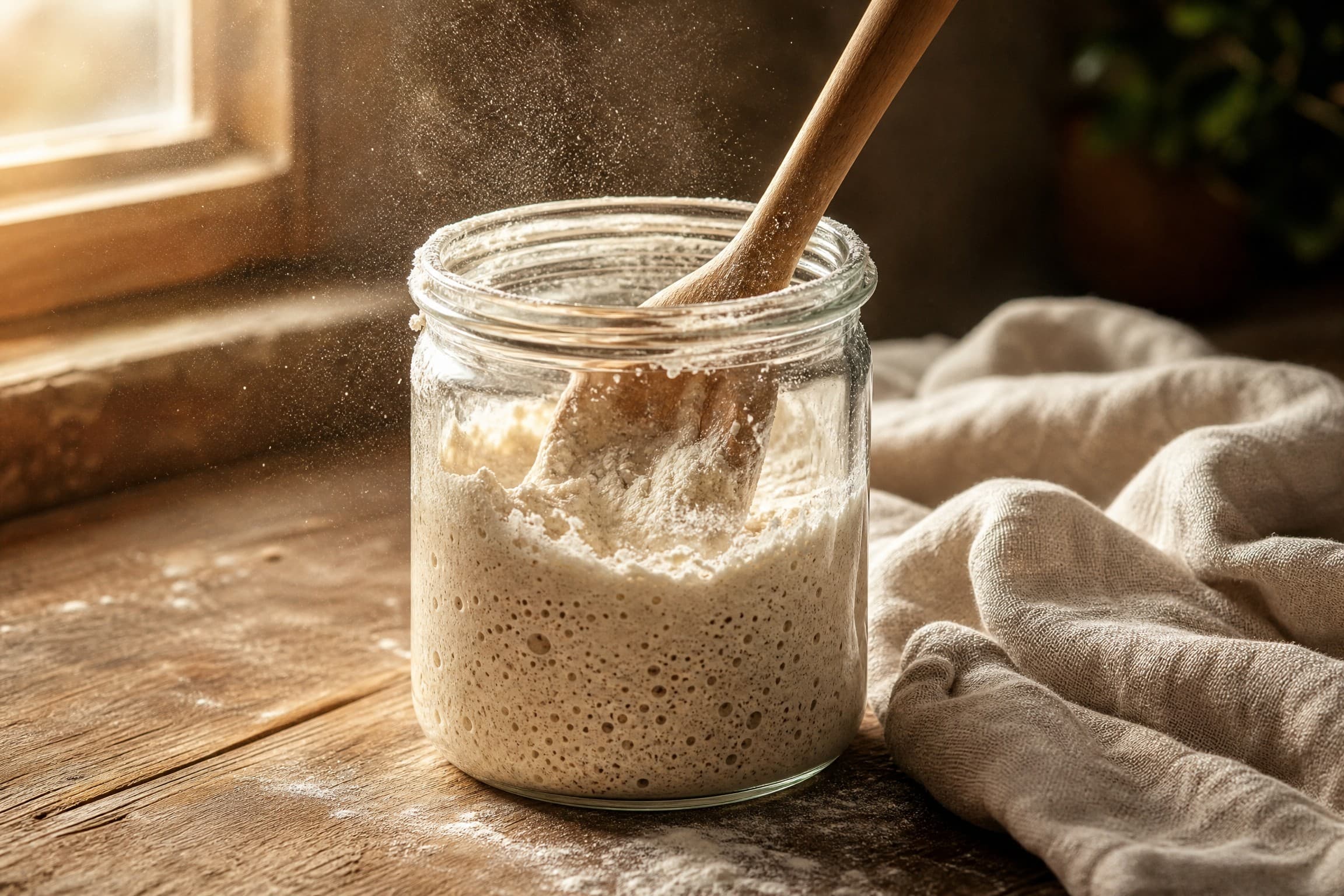
Hooch is the grey-brown liquid that collects on top of a hungry starter — alcohol and water produced by the microbes. It is not rot and it is not death. Two options: pour it off for a milder loaf, or stir it in for a bolder, more sour flavor. Either way, feed immediately. Repeated hooch within a day or two of feeding means the ratio is too large or the jar is too warm — cut back the feed or move it somewhere cooler.
The peak window
Peak is the moment your starter is doubled, domed and full of gas — usually 4–6 hours after a 1:1:1 feeding at 75–80°F (24–27°C). This is the only window worth baking with. Before peak, the culture is still waking and under-strength. After peak, it runs out of food, collapses and produces hooch — a jar that has visibly fallen is past its prime for baking. Mark the jar at the fill line and watch the dome: you'll learn your starter's exact rhythm in a week. That rhythm is the heartbeat of every recipe you bake.
How much starter to keep
Keep 20–50 g. A 20 g base fed 1:1:1 gives you 60 g — plenty for most single loaves. Keeping a 500 g jar is a waste of flour, fridge space and discard. More starter does not mean more strength; the culture multiplies to match its food regardless of the size of the jar.
Why the discard waste math works
Every feeding doubles the microbial population. If you never removed any, the jar would run out of food within hours and the culture would starve and sour. Discarding forces a reset: the remaining microbes get fresh food and multiply again and that renewal is what keeps the starter strong. So the waste math works because the discard isn't really waste — it's the price of a healthy culture and you can spend it on pancakes, crackers and brownies instead of throwing it away.
Reviving a neglected starter
A starter that sat for weeks — dark, crusted, with a thick hooch layer — is almost always salvageable. Pour off the hooch, scrape away any crust, discard all but 20 g and feed 1:1:1 at 75–80°F (24–27°C). Feed daily for 2–3 days; the smell should shift from sharply vinegary to pleasantly sour as the balance recovers. One exception: pink, orange, or green patches, or a smell like rotting food — that's contamination, not hibernation and the jar should be started fresh. A revived starter bakes again with a week of patience.
Seasonal adjustments
Your starter notices the seasons before you do. In summer, the peak arrives faster and the hooch forms sooner — feed 1:2:2 in the evening for a morning peak. In winter, the same starter crawls; use lukewarm water and give it a warm spot. Humidity changes the flour's thirst too: on humid days, a 1:1:1 feed may look too slack — that's water in the air, not a problem. The adjustment is simple: watch the dome, not the calendar and the jar will tell you what the season needs.
Frequently asked questions
How often should I feed my sourdough starter?
Daily if it lives on the counter, every 1–2 weeks if it lives in the fridge. The rule that matters more: feed before a bake and again after the jar returns to the fridge. A consistent 1:1:1 feeding at the same time each day is what builds a strong, predictable starter.
Can I overfeed a sourdough starter?
Yes and it's more common than underfeeding. A 1:5:5 feeding floods a young or tired culture with more food than its microbes can process, so it rises slowly, feels watery and develops hooch fast. Stay at 1:1:1 until the starter doubles in 4–6 hours, then scale up gradually if you need more.
How do I know my starter is ready to bake with?
Three signals: it doubles within 4–6 hours of a 1:1:1 feeding, the surface domes slightly instead of collapsing and it smells pleasantly sour, like yogurt. The float test is a handy extra: a spoonful that floats in water is near peak. Baking outside that window is the most common starter-related mistake.
Should I feed my starter bread flour or all-purpose flour?
Bread flour or whole wheat builds a stronger, faster-rising starter; bleached all-purpose ferments noticeably slower. Any unbleached flour works in a pinch — consistency matters more than the specific bag. Switch flours slowly if you switch at all and give the culture two or three feedings to adapt.
Can you dehydrate and rehydrate a sourdough starter?
Yes, and it is the best backup you can keep. Spread a thin layer of ripe starter on parchment and dry it at the lowest oven setting or in a dehydrator until it is fully brittle, then crumble the flakes into an airtight jar — they keep for months. To revive, stir the flakes into equal weights of flour and water and feed daily; the culture usually wakes within 2-3 days. Dried starter is also how people safely mail cultures to each other.