What Is a Levain? (And How It's Different From a Starter)
A levain is a portion of your sourdough starter fed fresh for one recipe. Learn how to build one, why bakers do it and how it differs from a starter.
By Maya Ellison · Reviewed by Maya Ellison · Updated August 18, 2026 · 4 min read
Quick answer
A bread levain is the tool bakers reach for when they want the flavor and rise of their starter but in a controlled, recipe-sized dose. It looks like a starter, smells like a starter and is made of the same things — because it is your starter, measured fresh. This guide explains what a levain actually is, why recipes ask for it and how to build one without overthinking it.
What a levain is
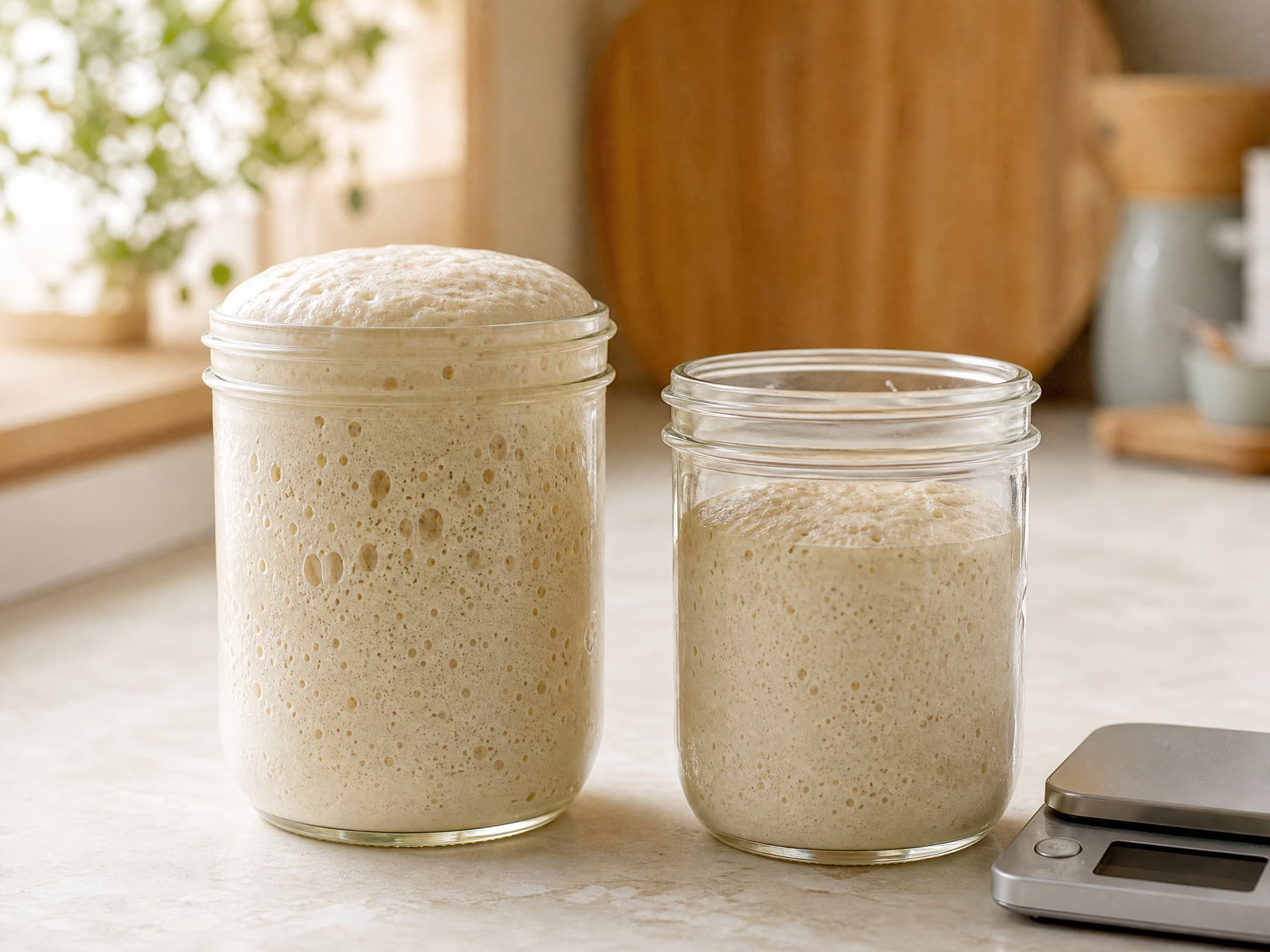
A levain is a portion of your sourdough starter that you feed separately, in a specific amount, for a specific bake. Where your starter lives in a jar and gets fed on a maintenance schedule, a levain is built once, used once and then it's gone — poured into the dough or fed back into the jar.
| Starter | Levain | |
|---|---|---|
| Purpose | Permanent culture, maintained long-term | One-time feeding for a single recipe |
| Size | Whatever you keep in the jar | Exactly what the recipe needs |
| Ratio | Whatever your maintenance schedule uses | Set by the recipe |
| Life cycle | Kept alive indefinitely | Built, peaked, used, gone |
| Culture | Your house culture | The same culture, freshly fed |
That last row is the whole point: the levain and the starter are the same living thing. Building a levain is not creating a new culture — it's giving your existing one a fresh, measured meal.
Why bakers build a levain
Three practical reasons show up in real recipes:
1. The recipe needs more starter than your jar holds. A high-hydration or high-starter-percentage dough can call for 150-300 g of starter. If your jar holds 80 g at peak, you either build a levain or enlarge your jar. Building a levain keeps the main jar small, easy to maintain and fed on its own schedule.
2. Predictable timing. When you build a levain from a freshly fed starter at a known ratio and temperature, its peak time becomes predictable to within an hour. That lets you schedule the mix around your day, not around the jar. Predictability is the quiet superpower of the levain.
3. Flavor control. The ratio and ferment time of a levain shape how sour the final bread is. A young, warm, high-ratio levain produces a milder loaf; a mature, cool, long-fermented one goes deeper and tangier. Building a separate levain lets you dial that knob without disturbing your main culture.
How to build a levain
- Decide the size. The recipe usually tells you: "build 150 g levain" or "80 g levain at 1:1:1." If not, use about 10-20% of the dough's flour weight. For a 500 g flour dough, that's 50-100 g of levain.
- Weigh it. In a clean container, combine ripe starter, flour and water in the recipe's ratio. At 1:1:1, that's equal parts by weight: 50 g starter + 50 g flour + 50 g water = 150 g levain.
- Mix and cover. Stir until no dry flour remains, cover loosely and set in a warm spot, 74-78°F (23-26°C).
- Watch for peak. A levain built from an active starter peaks in about 6-10 hours — domed, doubled and full of bubbles, still holding its shape. Use it at peak, before it starts to fall.
- Feed the jar. Put whatever remains back into your main starter jar and feed it normally. The jar is untouched by the levain process.
Common mistakes
- Building from a weak starter. A levain can't fix a jar that wasn't ready. Build from starter that already doubles in 4-6 hours at warm room temperature.
- Cold counter, short timeline. A 1:1:1 levain at 65°F (18°C) can take 16+ hours. Either build it earlier, or put it somewhere warm.
- Missing the peak. An under-risen levain produces weak dough; an over-risen one has gone acidic and will make a flat, sour loaf. Set a timer and check hourly in the final stretch.
- Forgetting the main jar. While you're fixated on the levain, the starter can go hungry. Feed the jar at the same time you build the levain and you'll always have culture to spare.
When to use a levain
Use a levain whenever a recipe calls for one explicitly, when you need more starter than your jar holds, or when you want precise control over the day's fermentation. For everything else, feeding your sourdough starter directly and baking at its peak is simpler and works beautifully — the main sourdough bread recipe takes that direct route. To see how the same culture behaves at different stages of its rise, the beginner's guide to sourdough walks through peak timing and the dough temperature guide explains the warmth that makes every rise predictable.
Frequently asked questions
What is the difference between a starter and a levain?
A starter is your permanent culture — the jar you feed again and again. A levain is a one-time portion of that culture, freshly fed at the exact weight and ratio a single recipe needs. Same microbes, different jobs: the starter is your long-term pet, the levain is a specifically sized portion built for the day's bake.
Do I always need to build a levain?
No. If your recipe's starter amount is small relative to your jar — say 100 g of a 200 g jar — just feed the jar to peak and use it directly. Build a levain when the recipe needs more starter than the jar holds, when you want a longer, more predictable ferment, or when the recipe explicitly calls for one.
Can I use levain as my starter afterward?
Yes. A levain is just fed starter, so you can pour it back into the main jar and continue feeding it normally. Many bakers run a single jar, build a levain for the day's bake, then feed the remainder as usual. You never need a second jar unless you're maintaining two distinct cultures.
Why did my levain not rise overnight?
Usually one of three things: too cold (below 68°F / 20°C it crawls), a starter that was weak or past its peak when you built it, or a ratio too large for the time you gave it. Warm it to 74-78°F (23-26°C), build it from a freshly peaked starter and scale the feeding to your timeline.