Potato Focaccia (Focaccia Pugliese) Recipe
Real Pugliese focaccia uses mashed potato in a near-100% hydration dough — soft, moist and impossibly tender, with the classic open crumb.
By Maya Ellison · Reviewed by Maya Ellison · Updated August 18, 2026 · 3 min read
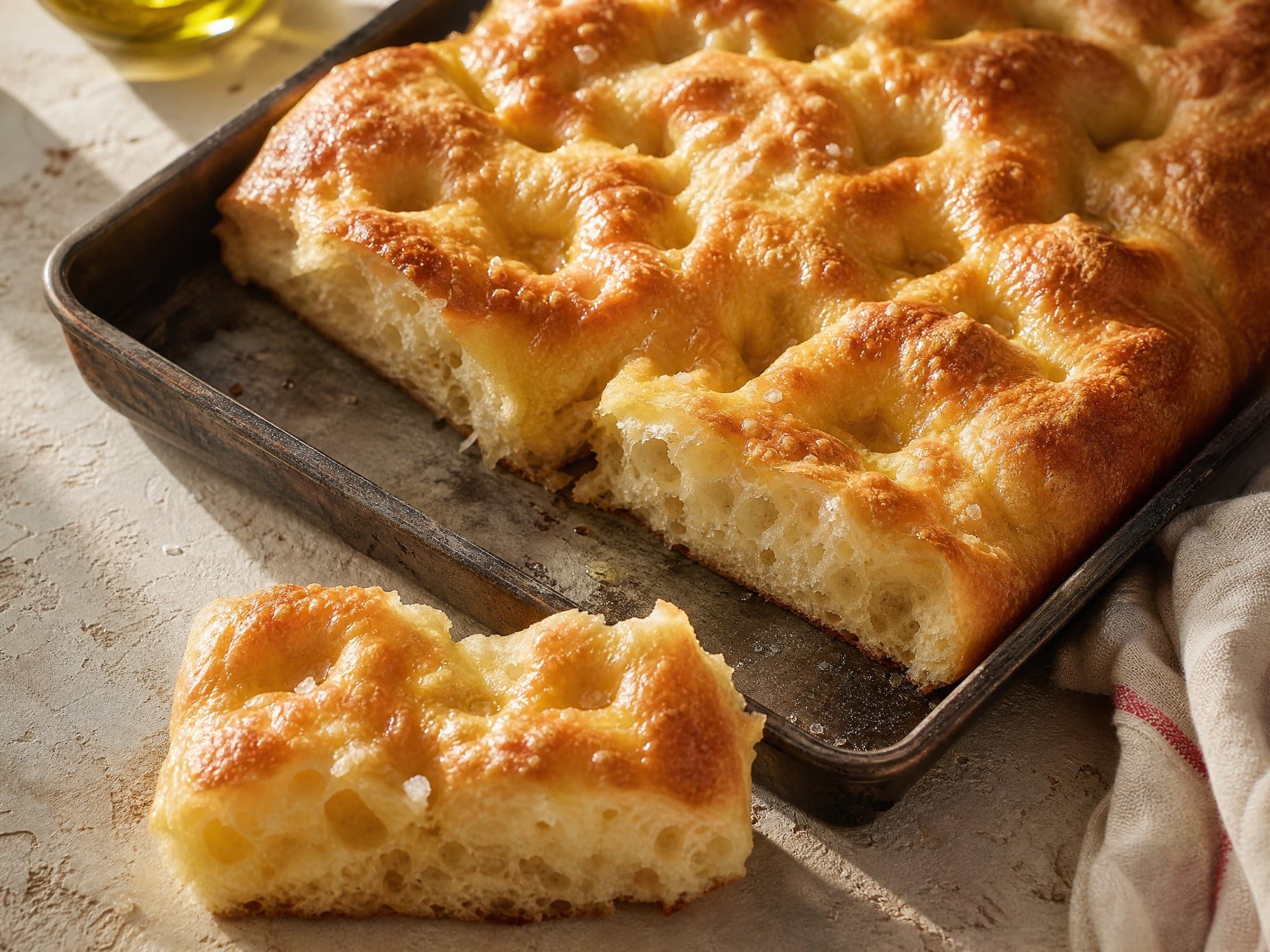
Focaccia with potato is the real Pugliese technique and it's the quiet secret behind the best focaccia you've ever eaten: mashed potato folded into a high-hydration dough keeps the crumb soft, moist and impossibly tender for days. This potato focaccia recipe is the authentic focus of it — a sourdough version of focaccia pugliese at roughly 100% hydration (counting the potato's own water), dimpled, rosemary-topped and sopping with olive oil in the way that made Puglia's bakers famous. It bakes in under 30 minutes, the dough comes together in a single bowl and the total timeline is a relaxed 5 hours — most of it idle fermentation.
Why this recipe works
Potato contributes what flour cannot: starch that holds water. When you fold 300 g of plain mashed potato into the dough, the crumb gains a stable, slowly-releasing reservoir of moisture that a plain flour-and-water dough simply doesn't have. The result is the signature focaccia pugliese texture — a crisp, olive-oil-golden top and bottom with a cloud-soft middle that stays that way into day three. The potatoes add no flavor of their own, which is precisely the point: they're a texture delivery system, not an ingredient you taste.
The potato technique
Boil, steam-dry, mash plain, weigh — four steps, four rules. Boil the potatoes fully tender so they mash without lumps (a lump is a pocket of wet failure in the dough). Steam-dry them on a tray so they don't add steam water to your hydration math. Mash them with no butter, no milk and no salt — fat coats the starch granules and dulls their water-holding job. And weigh the finished mash, not the raw potatoes; 300 g of mash is what the recipe's hydration math assumes. Bakers who skip these four rules wonder why their version underperforms. The rules are cheap; the result is not.
The hydration question
Honest accounting, because this confuses everyone: the recipe lists 380 g of water and 600 g of flour, which looks like a modest 63% hydration. But the mash carries about 210 g of water and the starter another 75 g — true hydration lands near 100% of flour weight. That's the high-hydration territory where the stretch-and-folds and the long proof matter most. When the dough feels alarmingly slack at the start, that's not a mistake — it's this recipe working. The folds transform it from porridge to silk over the first 90 minutes.
Swaps and variations
This dough is the friendliest high-hydration bake on the site and it takes additions well. Cherry tomatoes pressed into the dimples after the first proof; olives, folded in with the rosemary; caramelized onions and anchovies scattered on top before baking — all classic Pugliese neighbors. For a garlic version, warm 2 cloves of crushed garlic in the 40 g of pan oil so the flavor infuses before the dough ever lands. Rosemary is traditional; thyme and coarse salt work beautifully too. Whatever you add, don't reduce the oil — the oil is flavor, crust and non-stick all at once.
Storage
This is where focaccia pugliese genuinely beats its plain cousins: the potato's moisture keeps it soft for 3 days in the fridge and a good 2 on the counter, foil-covered. Reheat in a 350°F oven or toaster for 5 minutes and the crisp top returns; eat it cold and it still tastes like focaccia, not like bread regrets. It freezes for 2 months flat in a sealed bag — slice first, reheat straight from frozen and drizzle with one final pour of olive oil that makes it taste just-baked.
Ingredients
Weights in grams are the source of truth; cup measures are approximate.
- 600 g bread flour (or tipo 00, if you have it)
- 300 g mashed potato (from about 400 g raw potatoes, boiled and mashed plain)
- 380 g water, room temperature
- 150 g active sourdough starter (100% hydration)
- 12 g fine salt
- 30 g olive oil, for the dough
- 40 g olive oil, for the pan and dimpling
- 5 g coarse salt (fleur de sel or Maldon), for topping
- Fresh rosemary sprigs, for topping
Method
Boil the potatoes in salted water for 20-25 minutes, until completely tender. Drain, spread on a tray to steam-dry for 5 minutes, then mash smooth with no butter and no milk — dry, plain mash is what you want.
In a large bowl, mix the flour, water and starter into a shaggy dough. Cover and rest 30 minutes.
Add the mashed potato and the salt. Mix with a wet hand for 2-3 minutes — the dough will be loose and sticky; the potato makes it feel almost like a porridge. That's correct.
Work in the 30 g of olive oil, then cover and rest for 30 minutes.
Perform 3 sets of stretch-and-folds, 30 minutes apart, covering between sets. The dough will become glossy and elastic as the folds build structure.
Bulk ferment for a total of 3-4 hours at 75-78°F, until the dough is puffy and spongy — nearly doubled but not frothy.
Pour the 40 g of olive oil into a 13 x 18 inch sheet pan and swirl to coat the bottom. Slide the dough in and gently coax it toward the corners — it won't reach them yet.
Cover and rest for 45-60 minutes, then stretch the dough carefully to the pan's corners, letting it relax between tugs rather than forcing it.
Dimple the full surface with oiled fingertips, pressing firmly to the pan bottom — the oil wells up in each dimple, which is exactly the look you want.
Tuck the rosemary sprigs into the dimples and scatter the coarse salt over the top.
Cover and proof for 1-2 hours more, until the dough is pillowy and jiggles when the pan is tapped.
Bake at 425°F for 22-25 minutes, until the top is deeply golden with crisp-edged dimples and the underside is fried-golden with oil.
Drizzle with a last pour of olive oil, cool 10 minutes in the pan, then lift out with a spatula. Cut with a knife, or just tear.
Frequently asked questions
Why does focaccia have potato in it?
Potato starch holds water the way wheat starch can't — it traps moisture in the crumb, which is why focaccia pugliese stays soft and moist for days when a plain focaccia is dry by the afternoon. That's the actual Pugliese technique, not a gimmick: in Puglia, potatoes have been going into bread dough since they were cheap and abundant.
What's the hydration if there's potato involved?
Counting just the flour and water, this dough is about 66% hydrated. Add the potato's own water — roughly 210 g of it in our 300 g of mash, plus the starter's 75 g — and true hydration lands near 100%. That's why the dough feels wet at every step. Judge the dough, not the number; it should be slack, glossy and alive.
Can I use all-purpose flour or type 00?
Yes. Bread flour is the default here — its protein handles the high-hydration stretch-and-folds without tearing. Tipo 00 gives a softer, more traditional crumb; drop the water by 20 g if you use it. All-purpose works in a pinch with 30 g less water. Whole wheat works too but turns the golden crumb brownish and loses some of the delicate texture.
How do I store focaccia pugliese?
Unexpectedly well: cover the pan tightly with foil or transfer to an airtight container and it stays soft for 3 days in the fridge — the potato is doing its moisture-holding job. Reheat slices in a 350°F oven or toaster for 5 minutes; they crisp back and almost taste fresh. Focaccia also freezes perfectly for 2 months, wrapped well, reheated straight from frozen.