Best Bread Lame for Scoring Sourdough
How to choose a bread lame for scoring sourdough: fixed vs interchangeable blades, angle, safety and spares — plus the scoring tool we actually use.
By Maya Ellison · Reviewed by Maya Ellison · Updated August 29, 2026 · 3 min read
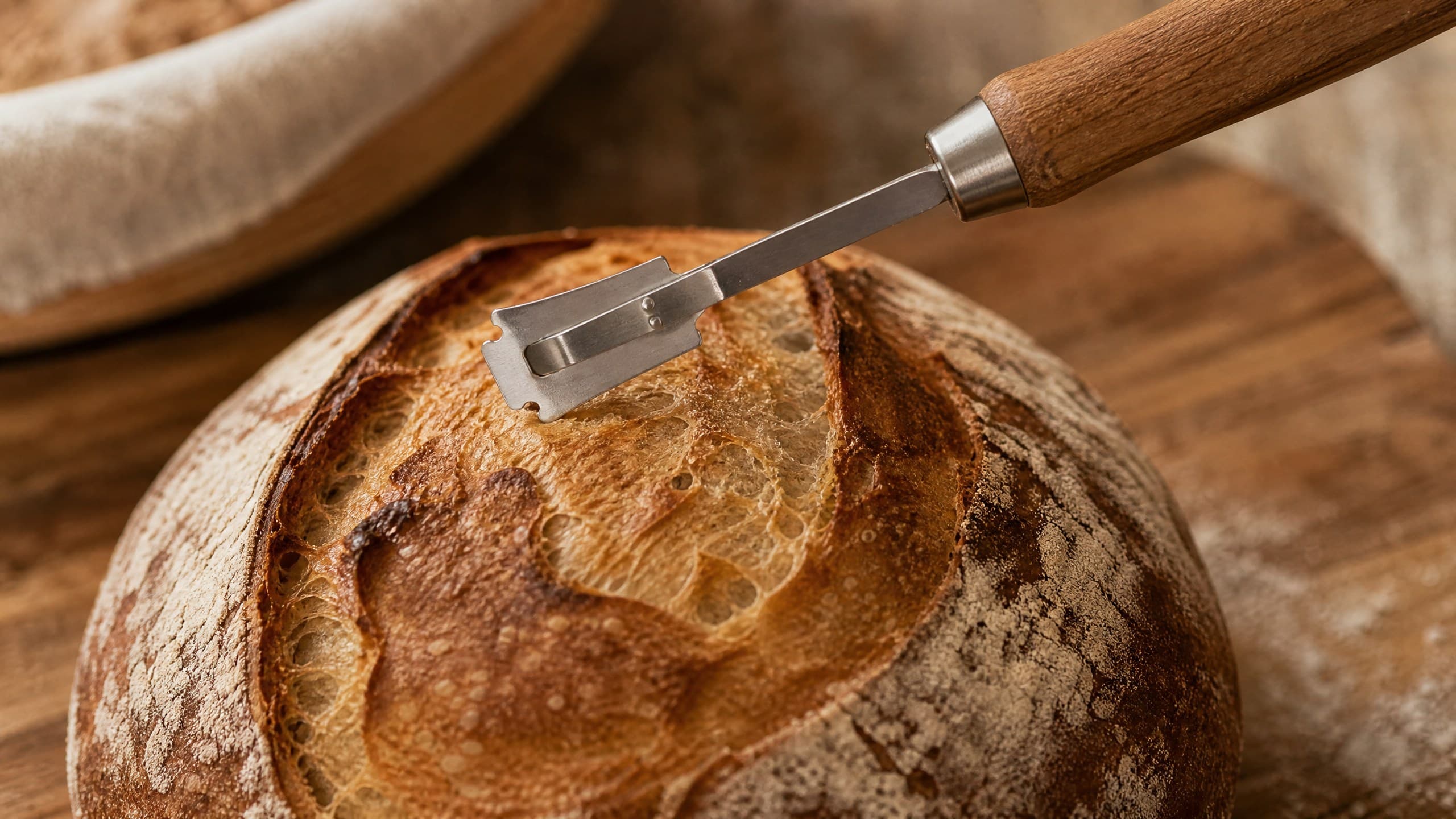
Quick answer
A bread lame for scoring sourdough is the small tool with the biggest visual payoff. The score you cut into a proofed loaf is a controlled weak point: as the oven heat hits, gas pushes through that cut and the flap lifts into an "ear" while the rest of the crust sets. A confident score needs a sharp, shallow-held blade — and that's exactly what a lame is built to give you. A knife can sort of do it, but it's thick, drags, and tears the skin.
Why a lame matters
Scoring isn't decoration — it's pressure relief. An unscored loaf bursts wherever the weakest spot happens to be, usually mid-side, with no ear and an uneven shape. A lame lays down a clean, deliberate cut so the loaf opens where you want, keeps its height, and bakes into the round or batard you shaped. A sharp razor held at a shallow angle is the whole trick; the handle just lets you hold it steady and safe.
What to look for in a bread lame
- Sharp, fresh razor blade. The single most important factor; dull blades drag and tear.
- Interchangeable blades. Swap a fresh razor in seconds instead of retiring the whole tool.
- Shallow, controlled angle. A good lame lets you hold the blade near-parallel to the dough for that ear.
- Comfortable, light handle. You want control, not a heavy grip that fights the cut.
- Safe storage. A cover, sheath, or retractable holder so the bare blade isn't loose in a drawer.
- Standard blade size. Uses common double-edge razors you can buy anywhere.
Types of lame compared
| Type | Good for | Blade | Pros | Cons |
|---|---|---|---|---|
| Interchangeable-blade lame | Everyday home baking | Standard razor | Fresh blade anytime, cheap to run | Blade can loosen if poorly made |
| Fixed-blade lame | Minimalist setups | Permanently set | Never loosens, tidy | Replace whole tool when dull |
| Curved-blade lame | Decorative curved scores | Razor, curved | Pretty arcs | Niche; less versatile |
| Pivot/rolling lame | Consistent angle repeats | Razor on arm | Repeatable angle | Bulkier, more to clean |
Interchangeable-blade lame
Pros: pop in a fresh razor when the edge dulls; uses cheap, common blades; light and easy to control. Cons: a cheaply made one may let the blade shift — buy one with a secure holder.
Fixed-blade lame
Pros: the blade never wobbles and the tool looks clean on the bench. Cons: once the edge goes you replace the entire lame, which costs more over time than spare razors.
Curved and pivot lames
Pros: curved blades make decorative arcs; pivot arms repeat a consistent angle across loaves. Cons: more specialized and bulkier than the simple handle-and-razor that most bakers need.
Our recommendation
Score just before the loaf goes into the preheated Dutch oven, hold the blade at a shallow angle, and don't second-guess the cut.
Buy on AmazonSee the score in action in the sourdough bread recipe, and if you're new, the beginner's guide to sourdough walks the whole bake start to finish.
Frequently asked questions
Fixed blade or interchangeable blades — which is better?
Interchangeable is more practical. A razor dulls after a few loaves and a dull blade drags and tears the skin; being able to pop in a fresh blade mid-session keeps scores clean. Fixed-blade lames look tidy and never loosen, but you replace the whole tool when the edge goes. For home use, interchangeable wins on cost and convenience.
What angle should I hold the lame at?
A shallow angle — roughly 30 degrees to the dough — gives the classic 'ear' where the flap lifts as the loaf bakes. Steeper, near-vertical cuts score deeper but open less dramatically. Practice the shallow drag; it's the move that makes a loaf look bakery-made.
Are bread lame blades just standard razor blades?
Most lames take a standard double-edge razor, the kind sold in any pharmacy. That's a feature: blades are cheap and everywhere, so you can keep a stack of fresh ones. Confirm the lame you buy uses a common blade size so you're never stuck waiting on a special order.
How do I store a lame safely?
A lame is a bare razor, so treat it like one. Many come with a blade cover or sheath; if not, cap the blade or retract it, and keep it away from dish towels and hands. Replace the blade the moment it starts to drag rather than pressing harder.