Best Stand Mixer for Sourdough (Dough Mixer)
How to choose a stand mixer for sourdough: bowl-lift vs tilt-head, motor power, dough hook and capacity — plus our pick for mixing stiff dough.
By Maya Ellison · Reviewed by Maya Ellison · Updated August 29, 2026 · 3 min read
Quick answer
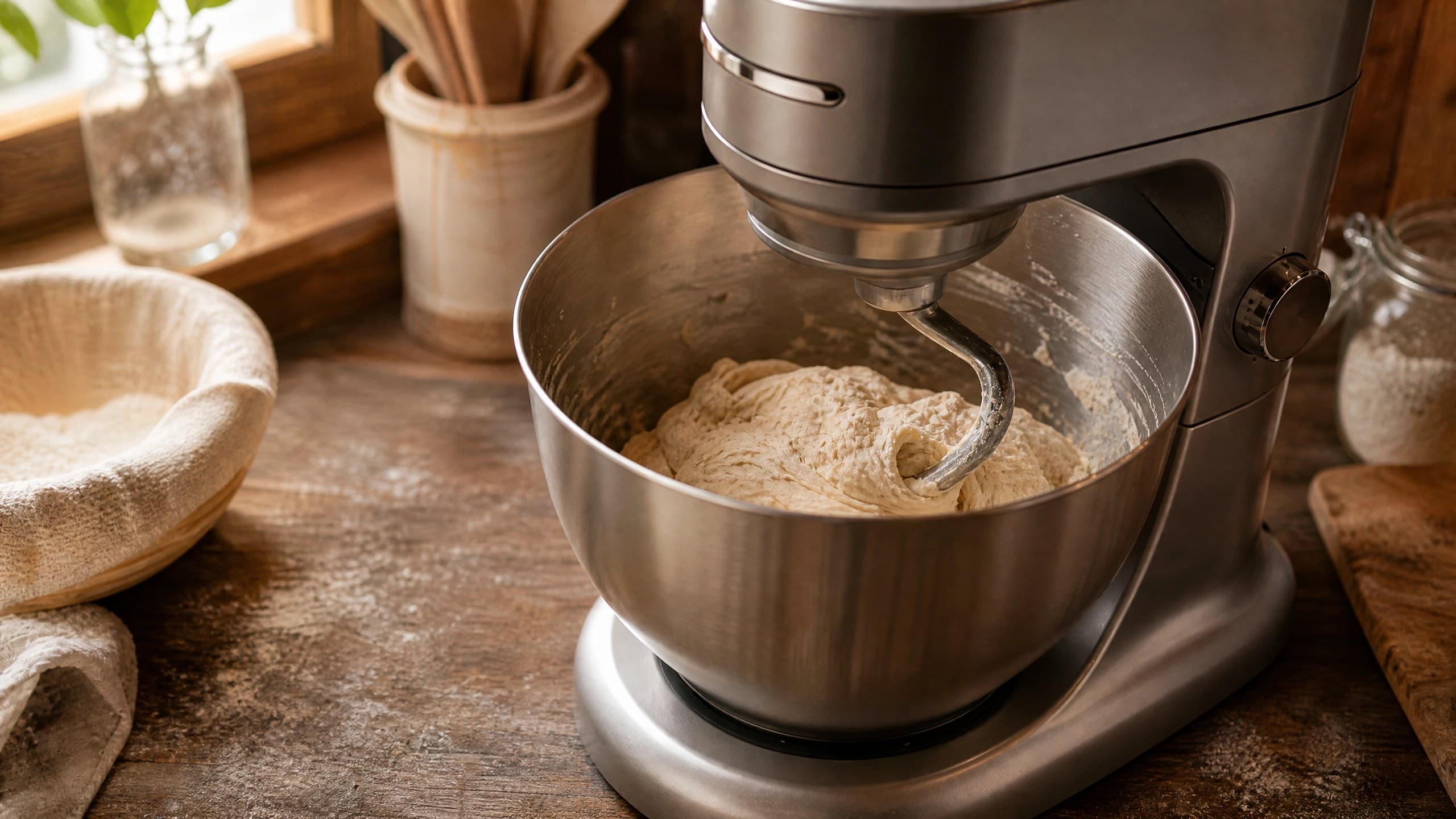
A stand mixer for sourdough — a real dough mixer — is the one tool that takes the workout out of building a strong, stiff loaf. Hand mixing with stretch-and-fold is the default here, and it's great. But when you're making low-hydration sandwich bread, a double batch, or your arms simply aren't interested, a capable mixer develops gluten in minutes instead of across a long series of folds. The catch: most mixers sold as "stand mixers" are built for cookies and meringue, not a 75% dough that fights back.
Why a dough mixer earns its counter space
Sourdough needs gluten development more than most breads. Without it, the dough won't hold the gas your starter produces and you get a flat, tight crumb. Hand mixing builds that strength through repeated stretch-and-fold, which takes time and a willing arm. A stand mixer with a dough hook does the same work mechanically — it kneads continuously, so the windowpane test arrives faster.
The honest take: you do not need a stand mixer to bake great sourdough. Plenty of bakers never own one. But if you bake often, make stiff dough, or have batches bigger than a single boule, a good mixer turns a 20-minute arm session into a 6-minute walk-away.
What to look for in a stand mixer for bread
- Motor of 500W or more. Dough is load, not air. A weak motor crawls, strains and trips its thermal cutoff mid-knead. 500W+ keeps the hook turning through a stiff 1 kg loaf.
- Bowl-lift design. The motor sits below a fixed, locking bowl. Under load it stays put instead of bouncing — critical for bread.
- A proper dough hook. A metal spiral or twisted hook, not the flat beater. Avoid the flimsy coated hooks if you mix weekly; the coating chips.
- Capacity of 5 quarts minimum. Two boules plus starter need headroom so dough doesn't climb the rim.
- A real planetary action. The beater rotates on its own axis while orbiting the bowl, so all the dough gets worked, not just a corner.
- One-bowl construction. Fewer seams means less dough trapped and easier cleanup.
Bowl-lift vs tilt-head
| Feature | Bowl-lift | Tilt-head |
|---|---|---|
| Stability under heavy dough | Excellent — locked, low motor | Good, but head lifts under load |
| Best for | Stiff dough, large batches | Soft, high-hydration, small batches |
| Footprint | Taller, narrower | Shorter, wider |
| Price | Higher | Lower |
A tilt-head machine is a fine first mixer for soft dough and the occasional loaf. The moment you lean into stiff sandwich bread or double batches, the bowl-lift model pays for itself in stability alone.
Our recommendation
Two honest caveats. If you only bake one soft, high-hydration boule a week, a tilt-head mixer — or no mixer at all — is plenty, and the bowl-lift premium is hard to justify. And remember the mixer only develops gluten; it doesn't replace bulk fermentation or the feel you get from stretch-and-fold. Use it to save your arms, not to skip learning the dough.
Buy on AmazonJust starting out? The beginner's guide to sourdough covers hand mixing and stretch-and-fold, and our classic sourdough bread recipe works with or without a mixer. Pair a mixer with a good kitchen scale so your grams stay exact through the whole batch.
Frequently asked questions
Can a stand mixer really handle sourdough dough?
Yes, with the right model. Sourdough is stickier and often stiffer than yeast dough, and it needs a long, slow mix to build strength. A 500W+ bowl-lift mixer does this well. A small tilt-head machine with a weak motor will struggle, crawl and overheat on a stiff 1 kg loaf.
Bowl-lift or tilt-head for bread?
Bowl-lift wins for dough. The fixed, lower motor and locking bowl keep the hook engaged under load, so it doesn't bounce or walk across the counter. Tilt-head models are fine for soft, high-hydration doughs and smaller batches, but the head lifts under resistance and feels less stable with heavy bread dough.
Do I need the spiral dough hook or the flat beater?
Use the dough hook, not the flat beater, for bread. The spiral (C-shaped) or twisted hook stretches and folds the gluten as it turns. The flat beater tears rather than develops dough and can overwork it. A metal hook outlasts the coated ones if you mix often.
Is a stand mixer better than hand mixing or a stretch-and-fold?
Hand mixing with stretch-and-fold is gentler and gives you more feel for the dough — and it's what most home sourdough bakers use. A stand mixer saves your arms on stiff dough and large batches, and it builds strength fast. Neither is 'wrong'; the mixer is a convenience, not a requirement.
How big a bowl do I need for a loaf of sourdough?
A 5-quart bowl handles two 900 g loaves comfortably; a 4-quart is tight for a single large boule plus starter. If you bake double batches or pan loaves, step up to 6–7 quarts so the dough has room to climb without spilling over the rim.