Sourdough Discard Muffin Recipe
Most sourdough discard muffins recipes need a fed starter; these discard blueberry muffins rise tall with unfed fridge discard in 15 minutes of mixing.
By Maya Ellison · Reviewed by Maya Ellison · Updated August 18, 2026 · 2 min read
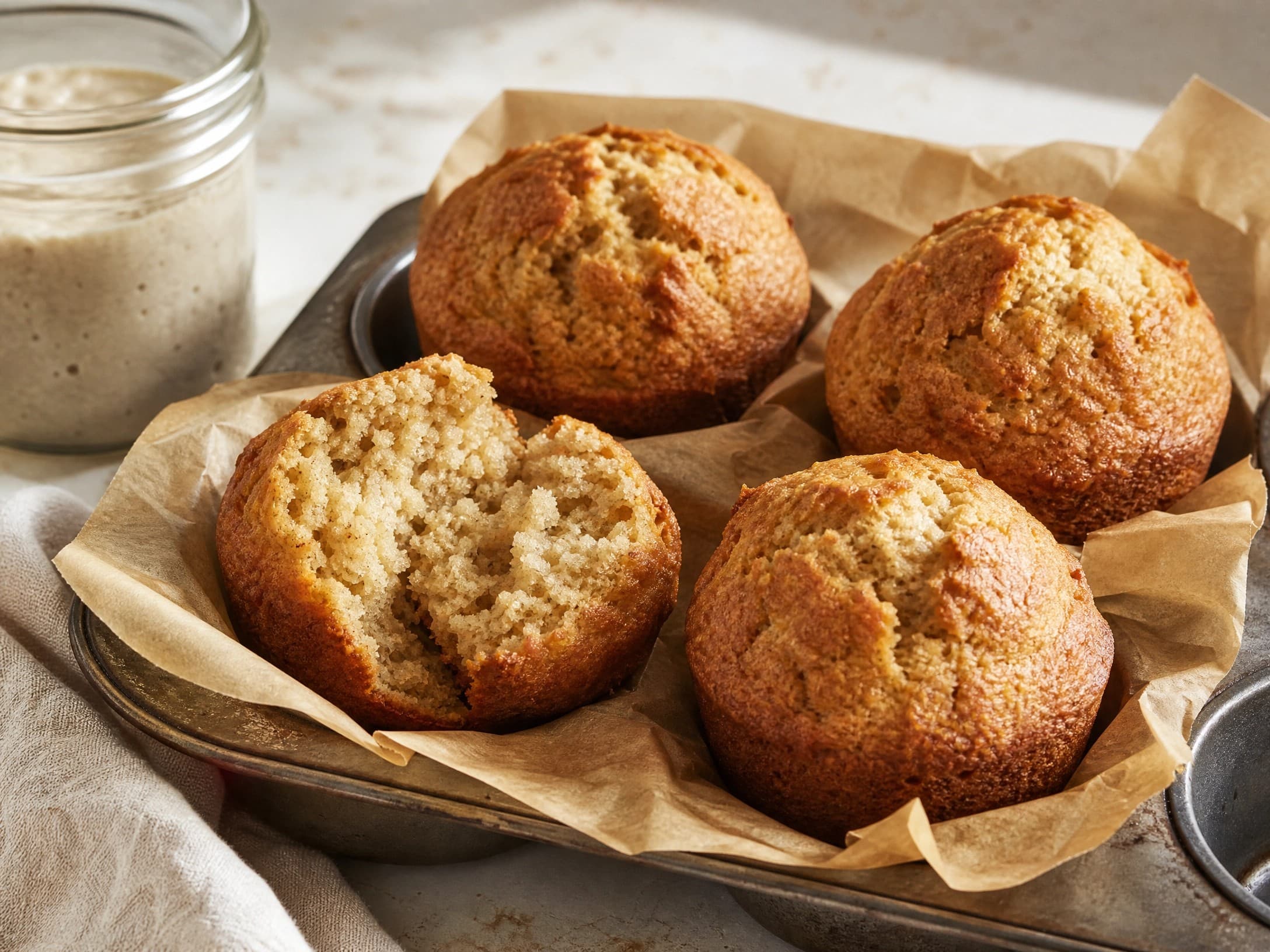
Sourdough discard muffins recipes share a promise: use the discard, keep the breakfast. These sourdough discard muffins are tender and domed — made with 150 g of unfed fridge discard, mixed by hand in 15 minutes and baked at 400°F for a tall, golden top. No feeding, no rising, no active starter required and the crumb stays soft for days.
Why this recipe works
The muffin method is the entire secret. Wet ingredients go into the dry, you stir in about 12 strokes and you stop. Gluten forms whenever flour meets liquid and gets stirred — every extra stroke trades a tender crumb for a rubbery one. The discard does the work that buttermilk does in a conventional muffin: it adds acid and moisture, which keeps the crumb soft and gives the rise a gentle, even lift alongside the baking powder and baking soda. The batter also rests 10 minutes after mixing, letting the flour hydrate and the leaveners get a head start — a short rest is one of the cheapest improvements you can make to any muffin. The result is a dome that puffs high, a middle that stays moist and a muffin built from ingredients you already have.
Notes on the discard
This recipe assumes a roughly 100% hydration discard — equal parts flour and water — straight from the fridge, hungry and unfed. That's not a bug; it's the ingredient. A thin, watery discard makes the batter loose and the muffin flatter, so pull 20-30 g of milk out and judge by eye. A stiff discard needs 20 g more milk. Anything else about the starter — its age, a layer of hooch, how long it sat — simply doesn't matter here. If you're unsure what your starter is doing, the sourdough starter guide explains the hydration math.
Blueberry, chocolate chip, or banana
The blueberry version is the flagship, but the batter is a one-bowl chameleon. Chocolate chip: fold in 150 g of chips instead of the berries, no other changes. Banana: mash 2 ripe bananas and cut the milk to 100 g — the batter will be a little looser, so bake 2-3 minutes longer. For frozen blueberries, skip the thawing entirely; a frozen berry holds its shape better and keeps the crumb from turning grey.
Storage
Muffins are best the day they're made, when the dome is crisp and the crumb is cloud-soft. They keep 3 days in an airtight container at room temperature and 3 months in the freezer. Thaw at room temperature and warm in a 350°F oven for 5 minutes to bring back the crust — skip the microwave if you care about the texture. That makes them a genuinely useful make-ahead: bake once and breakfast is sorted for the week. For more ways to spend a jar of discard, the sourdough discard recipes hub collects them all.
Ingredients
Weights in grams are the source of truth; cup measures are approximate.
- 250 g all-purpose flour (about 2 cups)
- 150 g sourdough discard (unfed, straight from the fridge)
- 120 g granulated sugar (about 1/2 cup plus 2 tbsp)
- 8 g baking powder (about 1 1/2 tsp)
- 2 g baking soda (about 1/2 tsp)
- 3 g fine salt (about 1/2 tsp)
- 2 large eggs (about 100 g)
- 120 g unsalted butter, melted and slightly cooled (about 1/2 cup)
- 150 g whole milk or buttermilk (about 2/3 cup)
- 1 tsp (4 g) vanilla extract
- 150 g fresh or frozen blueberries (about 1 cup)
Method
Heat the oven to 400°F and line a 12-cup muffin tin with paper liners.
In a large bowl, whisk the flour, baking powder, baking soda and salt until evenly combined.
In a second bowl, whisk the eggs, then the melted butter, milk, sugar, vanilla and sourdough discard, until smooth.
Pour the wet into the dry and fold with a spatula in 10-12 lazy strokes. Stop while the batter is still shaggy with a few streaks of flour — lumps are the point and overmixing is the enemy of the dome.
Scatter the blueberries over the batter and fold with 3 more strokes.
Rest the batter 10 minutes on the counter. The flour hydrates, the baking powder gets a head start and the domes come out taller.
Divide the batter among the 12 cups, filling each about three-quarters full. Don't smooth the tops.
Bake 18-22 minutes, until the tops are domed and golden and a toothpick comes out with just a crumb or two attached.
Cool in the tin 5 minutes, then transfer to a rack. Best the same day, with butter.
Frequently asked questions
Why are my sourdough discard muffins dense and flat?
Overmixing, almost always. This batter is mixed in 12 strokes on purpose. Gluten forms whenever flour meets liquid and gets stirred and every extra stroke trades a tender crumb for a rubbery one. Mix until the flour just disappears, then put the spatula down.
Can I use frozen blueberries?
Yes and you don't need to thaw them — frozen berries actually hold their shape better than fresh. Toss them in a tablespoon of the flour before folding so they don't sink to the bottom of the cups or bleed grey into the crumb.
Can I make chocolate chip or banana muffins instead?
Easily. Swap the blueberries for 150 g of chocolate chips, or fold in 2 mashed ripe bananas and cut the milk to 100 g. Both take the same batter and the same 400°F oven; the banana version just bakes 2-3 minutes longer.
My discard is thin and watery. Should I adjust anything?
A wet discard makes the batter loose and the muffin flatter. Cut the milk back by 20-30 g and judge by eye — the batter should be scoopable, not pourable. The reverse is true for a stiff, thick discard: add 20 g of milk.
Can I bake these as mini muffins?
Yes — a 24-cup mini tin takes about 10-12 minutes. Everything else stays the same. Use the same doneness test: domed tops and a toothpick with a couple of moist crumbs attached.