Best Bread Knife for Sourdough
The best bread knife for sourdough: why a long, sharp serrated blade stops squash, what to look for and our honest pick for crusty loaves.
By Maya Ellison · Reviewed by Maya Ellison · Updated August 18, 2026 · 4 min read
Quick answer
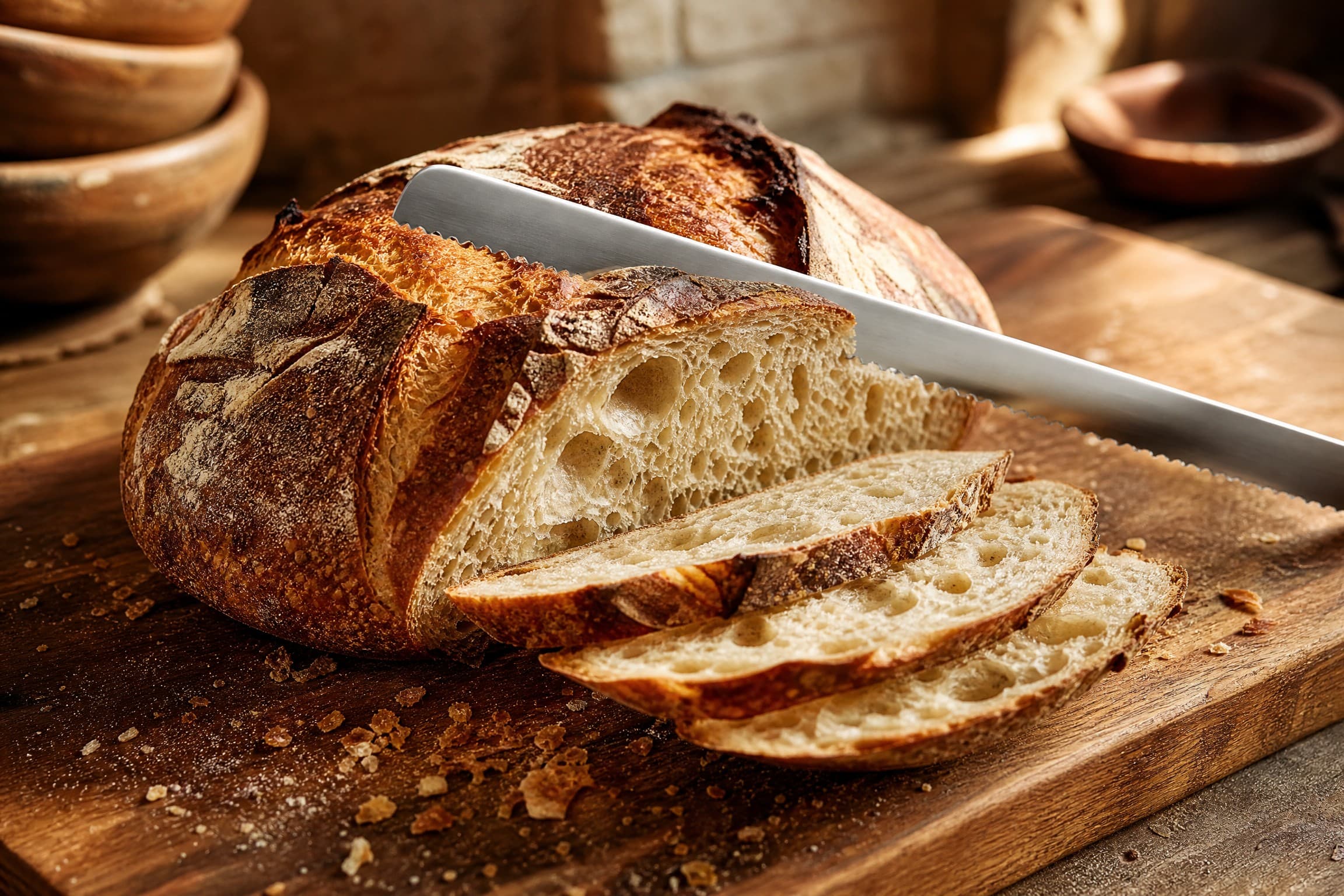
A bread knife for sourdough earns its place in the kitchen on the first cut. Sourdough has the hardest crust of any home-baked bread — thick, blistered and unyielding — wrapped around a soft, open interior. Press straight down with a short or dull blade and you crush the crumb before you ever reach the crust. A long, sharp serrated knife saws through the crust cleanly while the interior stays intact. It is the difference between a proud slice and a squashed loaf.
Why the knife matters
Sourdough bakers spend days on a loaf: feeding the starter, bulk fermentation, shaping, scoring, a steam-filled bake. Then one wrong cut flattens it. A dedicated sourdough bread knife — long, sharp and deeply serrated — is the tool that keeps all of that work intact. The physics are simple — crust is hard, interior is soft and any blade that pushes rather than saws transfers pressure through the whole slice. Serration is what grips the crust: each tooth bites, releases and advances, so the blade cuts on the downstroke and the crumb barely notices. Short blades make this worse, because you have to rock or press to cover the loaf's width. A long blade does the job in one smooth pass.
What to look for
- Serration pattern. Deep, scalloped serrations grip hard crust best; fine wave serrations work but tear the crumb more. You want teeth that bite, not scratch.
- Blade length of 9–10 inches (23–25 cm). Long enough to cross a boule in one pass. 8-inch blades force multiple strokes and more squashing.
- Curved or offset blade. An offset handle keeps your knuckles off the counter over a tall loaf; a slight curve matches the motion of sawing. Both are real improvements, not gimmicks.
- Comfortable handle. Balanced weight and a grippy, secure handle matter when you're cutting through a hard crust for a minute straight.
- Dishwasher-safe? Technically yes on some; in practice no. Dishwashers dull serrations fast, so plan to hand wash whatever you buy.
Four knives compared
| Type | Best for | Blade length | Serration | Cons |
|---|---|---|---|---|
| Budget serrated knife | First knife, occasional bread cutting | 8–10 in | Fine wave | Dulls fast, flexes on hard crust |
| Classic French-style | Traditionalists who value the feel of carbon steel | 10 in / 25 cm | Deep, aggressive scallops | Rusts if left wet, needs drying after washing |
| Offset or curved | Most home bakers | 9–10 in / 23–25 cm | Medium, angled blade | Sits awkwardly in a standard knife block |
| High-end forged | Daily sourdough bakers | 10 in / 25 cm | Precision-ground serrations | Expensive, still needs hand washing |
Budget serrated knife
Pros: cheap, does the job, replaceable without guilt. Cons: dulls within months, flexes on hard crust and a flexing blade is exactly what squashes a boule.
Classic French-style
Pros: the classic French serrated knife with a carbon-steel blade — deep scalloped serrations that tear through any crust, with a handle that ages beautifully. Cons: carbon steel stains and rusts if ignored, it's often not offset and a wet dishcloth on the counter is an accident waiting to happen.
Offset or curved
Pros: knuckle clearance over tall loaves, curved blade suits the natural sawing motion, medium serrations that stay sharp for years with hand washing. Cons: the offset handle doesn't sit flat in most knife blocks and it costs more than the budget option.
High-end forged
Pros: the best balance, a blade that glides through a day-old crust and a handle you'll trust for decades. Cons: real money, no faster or cleaner than a good mid-range knife at cutting bread — you're paying for feel and longevity.
How to cut without squashing
Three habits matter more than the knife:
- Saw gently. Let the blade travel back and forth across the crust; pressure does nothing except crush.
- Let the serration do the work. The teeth bite into the crust on their own. Guide the blade, don't drive it.
- Score deep. Keep a light, steady pressure aimed into the crust — the sawing motion should carry the blade through. A bread knife cuts like a saw, not like a guillotine.
Our recommendation
If you're still building your first loaf, the beginner's guide to sourdough covers the essentials and our classic sourdough bread recipe bakes the kind of crusty loaf this knife was made for. Cutting problems can also point back to the bake itself — the sourdough troubleshooting guide helps you tell a knife problem from a crust problem.
Frequently asked questions
Why does my bread squash when I cut it?
Two reasons: a dull or short serrated blade, or pressing straight down instead of sawing. A 10-inch knife with deep serrations lets you saw with the blade's full length, so the crust cuts cleanly and the soft interior keeps its shape.
How do I sharpen a serrated bread knife?
Serrated knives sharpen on a tapered rod that fits the scallops — a plain whetstone won't reach into the serrations. Run each scallop a few passes, hone between bakes and keep the edge clear of dishwashers. When the serrations go dull, most bread knives are cheaper to replace than to professionally resharpen.
Is an 8-inch bread knife enough, or do I need 10 inches?
An 8-inch blade works on small loaves, but a 10-inch (25 cm) blade covers a whole boule in one pass — fewer strokes means less squashing. If you bake sourdough regularly, buy 9–10 inches; 8 inches is fine for sandwich bread and baguettes.
Should a bread knife be dishwasher safe?
Treat it like a knife, not a spoon: hand wash it. The dishwasher's heat and detergent dull serrations faster and soften wooden or epoxy handles. A hand-washed bread knife stays sharp years longer.